Introducing 22oz Copper Insulated Water Bottles! Cold for 48 hours & Hot for 12. In the SHOP Now

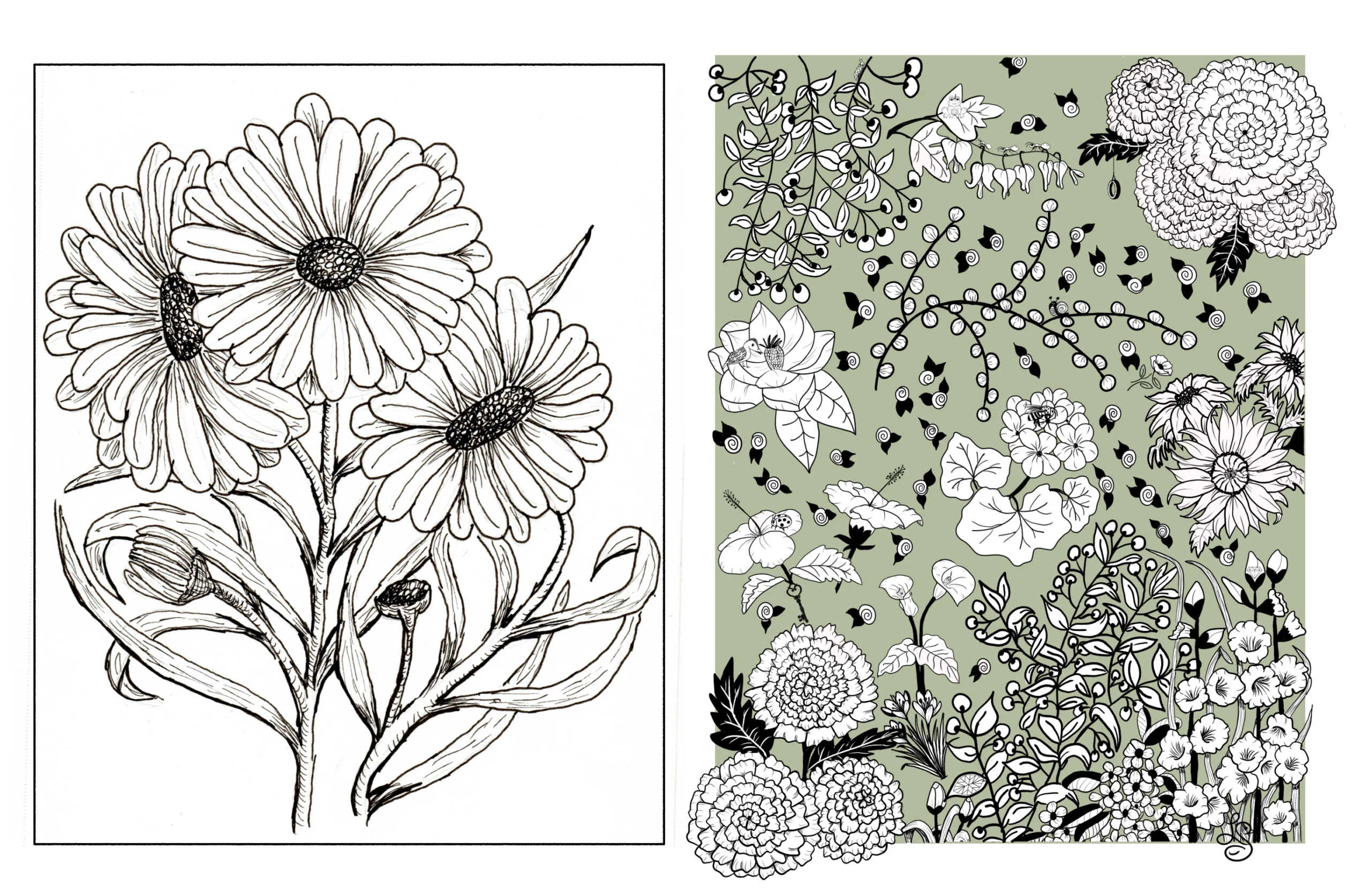
Subtraction Method for Beginners: How to Find Your Art Style
Most beginners try to find their art style by adding more, more techniques, more tools, more influences. The Subtraction Method works the opposite way. This is how I discovered my own style by eliminating everything that didn't feel right.
 ByLeona

The subtraction method will help if you are struggling to find your art style as a beginner. You’re probably just looking in the wrong direction.
Forget “finding your aesthetic.” Forget those vague blog posts about “discovering yourself through art.” I’m going to show you a simpler way: figure out what you hate.
So far, we’ve covered the “Talent Myth” and the “Gear Myth“. Today, let’s tackle the third trap: the “Style Myth.”
The Style Myth: Why “Finding Your Aesthetic” Advice Fails
My question for beginners is this: “How can you know your style if you don’t know your style?”
There is a cornucopia of blogs and videos promising to help you “discover your aesthetic/style.” But the problem is, most of them say a lot without actually saying anything useful. The more of these I read, the more confused I became.
So, I want to share with you a different approach: The Art of Subtraction or the subtraction method
Sometimes in life, it is easier to figure out what you don’t like than what you do.
The Old Way vs. The Subtraction Method Way
| The Conventional Advice | The Subtraction Method |
| “Look for what you love.” | Identify what you hate. |
| “Try to master everything.” | Eliminate entire categories. |
| “Add more techniques.” | Remove friction points. |
| Result: Overwhelm | Result: Clarity |
The Subtraction Method: A Different Approach to Discovering Your Style
The Subtraction Method Principle: How Elimination Reveals Clarity
Think about it this way: In my home, I do all the shopping and cooking. Trying to decide what to make for dinner every night can be exhausting.
But I have learned that if I ask my husband, “What do you want for dinner?” I will get the dreaded non-committal answer: “Anything sounds fine” or “Whatever you feel like.”
Instead, I learned to flip the script. I ask: “Does anything sound BAD for dinner?” or “Is there anything you definitively DO NOT want to eat?”
By asking one of these questions, I immediately reduce the number of options, making my choice easier.
This elimination strategy works for dinner decisions. It absolutely works for finding your art style.
The funny thing is, I didn’t set out to use this strategy. I didn’t start my drawing journey looking for things to hate. I just stumbled into them by accident.
How I Discovered What I DON’T Like to Draw
The Koala Incident: My First “Oh Hell No” Moment
On Day 8 of my journey, I ran right into my first “Oh Hell No!” moment.
If you are following the Mark Kistler book, Day 8 is the Koala lesson.
Now, the conventional wisdom is that everyone loves cute animals. If you want to be a popular artist, you should want to draw furry, cuddly creatures, right? Wrong. Be warned: this too is a myth.
I discovered my first “hate it” moment completely by accident on Day 8 of my drawing journey. The lesson? Drawing a koala bear.
Here’s what I learned: Not every artist needs to draw cute animals. In fact, discovering what you CAN’T STAND to draw is just as valuable as finding what you love.
So, I sat down, grabbed my pencil and sketchbook, ready to conquer another lesson. I read the prose and started the step-by-step process of drawing that cute little koala bear. I followed the instructions. I drew the nose, the ears, and the texture. Technically, I did it (even if it did look a bit goofy).
But as I was drawing, time dragged by. I swear I could even hear the digital clock ticking.
I wasn’t feeling the “flow” like I had on previous lessons; I was feeling vexed and frustrated. The rendering of the fur felt tedious to me, not relaxing.
When I finished, I had to force myself not to tear out that page of my sketchbook and shred it into as many little pieces as possible. Instead, I picked up my pencil and wrote a note right on the page.
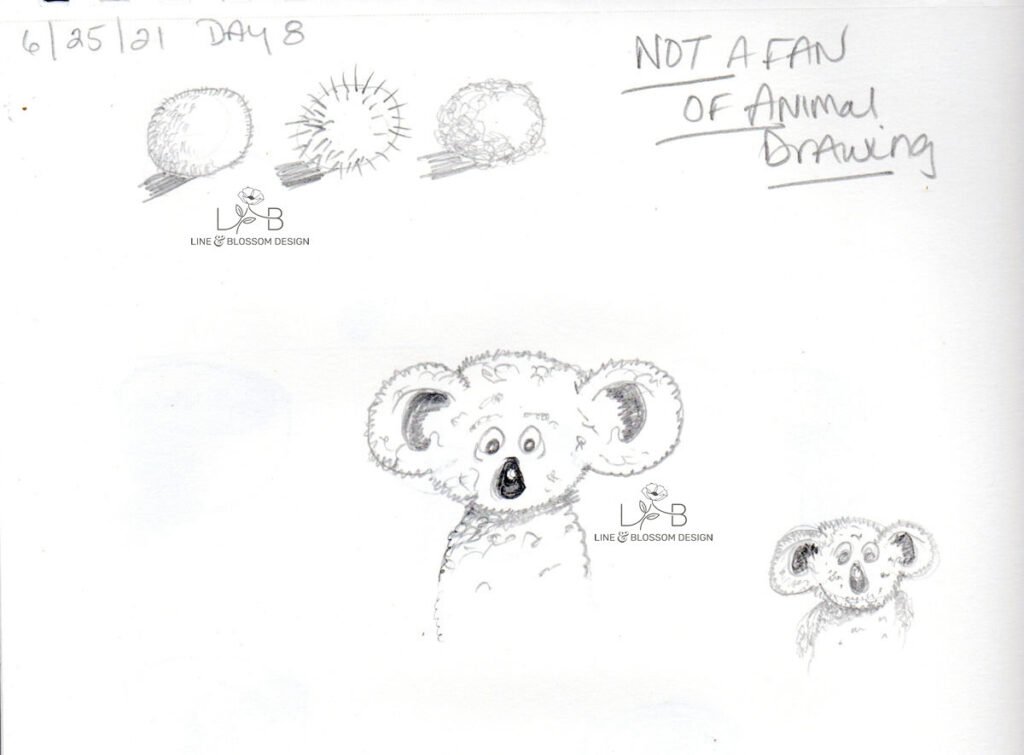
“Not a fan of animal drawing.”
That note was more valuable than the drawing itself. In that moment, I didn’t fail at art; I accidentally succeeded in the subtraction method. I successfully crossed “Pet Portraits” off my list. I learned that my style, whatever it was going to be, would not involve fur.
That single note, “Not a fan of animal drawing”, was worth more than hours of YouTube videos about “finding my aesthetic.” I had just eliminated an entire category: pet portraits, wildlife art, anything with fur. My potential style just got clearer.
When Your Dream Style Doesn’t Match Reality
Then there was the hardest subtraction of all: The subtraction method removed the Dream.
While I was working through the lessons, I drew a rose, and later a calla lily. Immediately, I knew. I loved it. I felt a connection to the curves and the organic shapes that I didn’t feel with anything else. It felt like my simple mechanical pencil turned into a magic wand.
But I had a problem. In my mind, I had always dreamed of being a Landscape Artist. That was the identity I wanted, the identity I craved. I wanted to be the person who captured sweeping vistas and mountains. I wanted to be the artist that made people stand and stare at my beautiful landscapes with their mouths hanging open, completely mesmerized by my art. I wanted to be like Bob Ross. This will be explained in my next post.
So, I tried to force it. I drew landscapes. But these two concepts, the dream and the reality, clashed on the page.
Read about how I wanted to be like Bob Ross
The full landscape didn’t work, so I thought maybe I just need to break it down into mountains, trees, and rocks, then put them together.
Short answer: Nope.
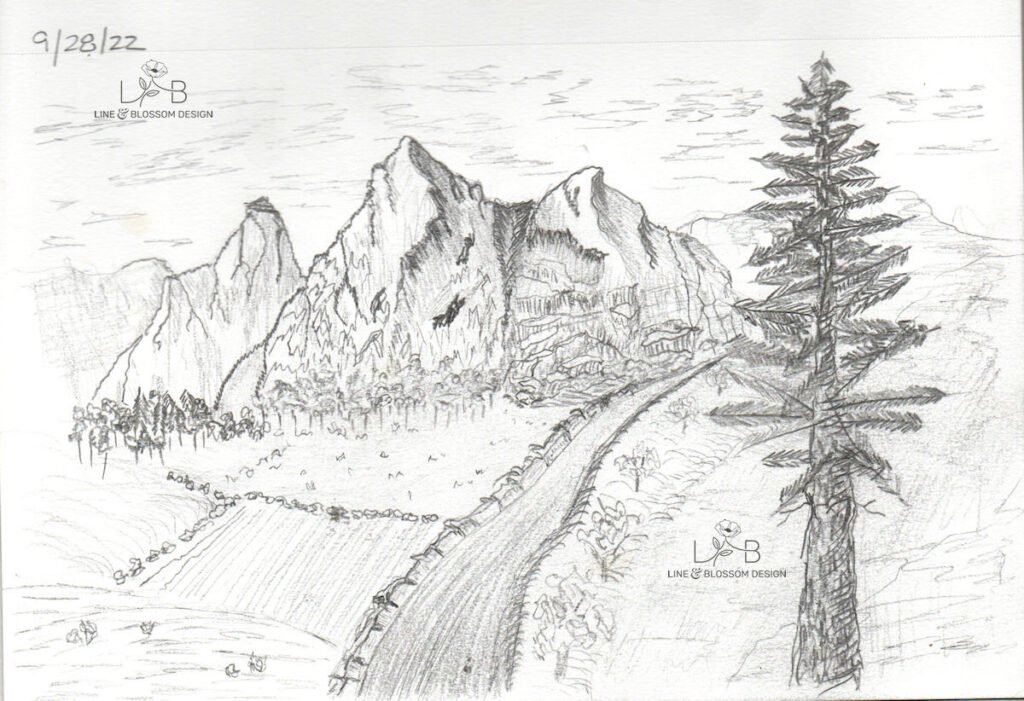
No matter how much I drew mountains to get better, no matter how many trees or rocks I drew, the result was the same. My landscapes were just drawings on a page, even as I improved the look of the things in the landscape.
This was a painful realization. To find my style, I didn’t just have to subtract the things I hated (like the Koala); I had to subtract the thing I thought I wanted. My Dream.
How many beginner artists are stuck drawing what they think they “should” draw instead of what actually flows naturally?
I had to let go of the “Landscape Artist” dream to make room for the “Botanical Artist” reality. And once I did, everything clicked.
The Subtraction Method Led to Discovery: How I Found Botanical Art
The Survivor (Line & Blossom Design)
So, I employed the subtraction method.
I subtracted the fur because I hated the process. I subtracted the pencil landscapes because they felt soulless.
And what was left standing after using the subtraction method? The flowers
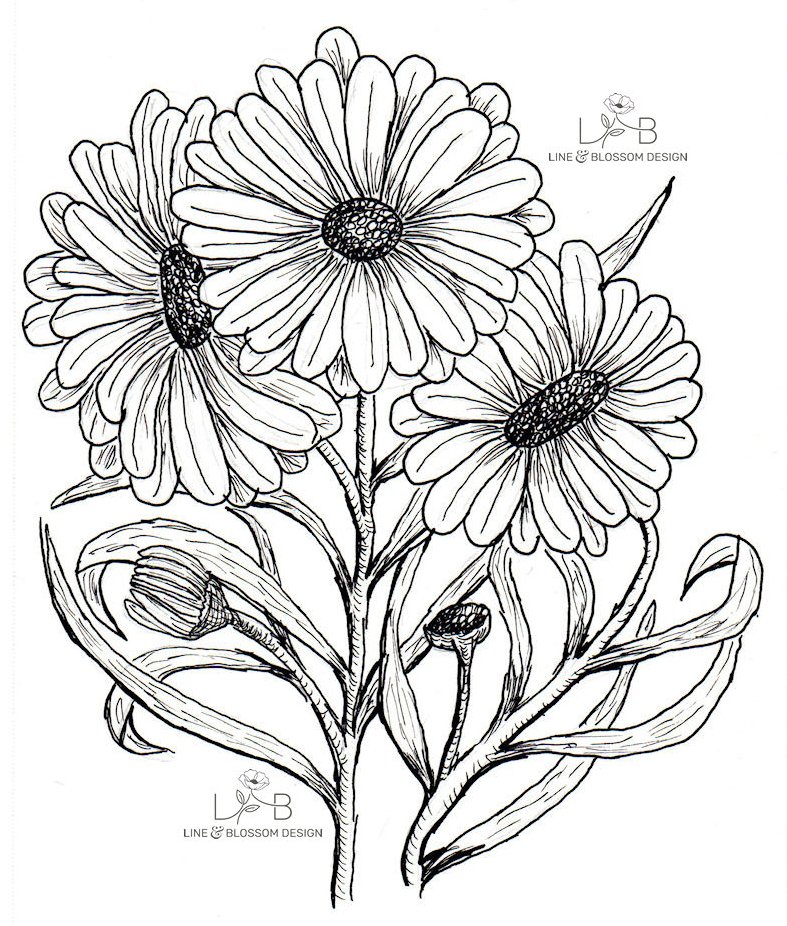
When I looked at my drawings of flowers, like these daisies I drew, I didn’t see friction or amateurish attempts. I saw me. I saw something that made me smile, something that gave me internal joy.
I loved the clean lines. I loved the organic shapes. I didn’t have to force it; the ink just seemed to know where to go. When I was in the zone drawing my flowers, needless to say, I didn’t hear the digital clock ticking.
By quitting the things I thought I “should” do, I accidentally uncovered the thing I was meant to do.
What Survived: The Line & Blossom Origin Story
These daisies weren’t just a drawing, they were a revelation. The clean lines. The organic shapes. The joy I felt creating them. This wasn’t just what survived the subtraction method; this was the foundation of what would become my entire artistic identity and eventually, my business.
That realization didn’t just give me a hobby; it gave me a direction. It is the reason my online store is named Line & Blossom Design. It isn’t named “Line & Mountain” or “Line & Koala.” It is named after the only thing that survived the subtraction method.
Every print in my shop features botanical subjects, flowers, leaves, organic forms and some hidden items for you to find. No koalas. No landscapes. Just the clean lines and natural shapes that survived my subtraction method process. That’s not limiting my business; it’s defining my brand.
Caption: “The Evolution. From that first simple daisy sketch to my current work today. This is what happens when you focus only on what you love to draw.”
Your Turn: The 3-Step Subtraction Method
If you are struggling to find your style, stop looking for what you love. That is too much pressure.
Instead, start looking for what you hate.
Step 1: Draw Everything (For Now)
As a beginner, try different subjects from your drawing book or tutorials. Don’t skip lessons just because they don’t appeal to you initially. You need data points, just like a computer analyzing probability or well AI learning to help you with your prompts.
Step 2: Notice Your Friction
While drawing, pay attention to:
- Do you check the clock? (Sign you hate it)
- Does time fly by? (Sign you love it)
- Do you feel frustrated or peaceful?
- Do you want to show people or hide it?
Step 3: Write It Down
Keep a “Hate It” list right in your sketchbook:
- Fur/texture (Koala – felt tedious)
- Landscapes (Wanted to love it, but felt flat)
- Flowers (Time disappeared, felt natural)
What survives when you use the subtraction method is your style.
What Other Artists Have Subtracted (And Why That’s OK)
You might subtract:
- Realism (and lean into stylized/abstract)
- Color (and embrace pen & ink)
- Detailed backgrounds (and focus on subjects)
- Human figures (and discover still life)
- Modern subjects (and love vintage themes)
Every professional artist has a “won’t draw” list. That’s not limiting, that’s focus.
But Shouldn’t I Be Able to Draw EVERYTHING?
No. That’s the myth talking.
Name one famous artist who draws “everything”:
- Claude Monet → Water lilies and landscapes
- Georgia O’Keeffe → Flowers and southwestern scenes
- Charles Schulz → Peanuts characters
Mastery comes from focus, not from being mediocre at everything.
Create Your “Hate It” List
If you are struggling to find your style, stop looking for what you love. That is too much pressure.
Instead, start looking for what you hate.
- If you draw a face and it feels like a chore, write “No Portraits” in the margin.
- If you draw a building and feel bored, write “No Architecture.”
Keep subtracting until there is only one thing left on the page. That thing, the survivor, is your style.
This is Phase 1, be sure to check back for Phase 2.
Start Your Own Art Style Discovery Journey
Your Assignment (If You Choose to Accept It):
1. Draw 5 different subject types this week (as an example):
- An animal
- A landscape or building
- A person or portrait
- A plant or flower
- An abstract pattern
2. After each one, write ONE WORD in the margin:
- “Tedious” / “Boring” / “Frustrating” = Subtract it
- “Flow” / “Fun” / “Natural” = Keep exploring these
3. Come back in a week and look at your notes. The pattern will surprise you.
The survivor is your style. Now go find it.
What To Do Next
Once you have completed this phase of the subtraction method and found what you love to draw, next you need to figure out how you want to draw it. For advice on how to do it read After the Art of Subtraction: How to Find Your Art Style That ‘Sings’
