Introducing 22oz Copper Insulated Water Bottles! Cold for 48 hours & Hot for 12. In the SHOP Now

Learn Draw at Any Age: From No Talent to Artist at 55
Can you really learn to draw as an adult? After 50 years of believing the talent myth, one book changed everything. This is the story of how I went from "no talent" to artist at 55, and why drawing is a skill anyone can learn.
 ByLeona

Can you really learn to draw at any age or as an adult? Growing up in a family full of artists, painters, and experts at crafts, I heard one refrain constantly: “You don’t have any talent. Just give up.”
As you can imagine, over time I began to believe them. I gave up on ever being able to draw or create, even though this left a void in my life and heart. I am sure many of you have been convinced of this same “Talent Myth.”
But I am here today to tell you that drawing is not a talent; it is a learnable skill that anyone can achieve, regardless of age. All you need is the knowledge of how to draw, the guidelines to follow, and the time to practice. As a woman who didn’t start her drawing journey until age 55, I am living proof that this is a skill you, too, can learn.
So, how did I finally fill that void? It started with a single book.
The Talent Myth That Held Me Back
For 50 years, I believed I had “no talent” for drawing. My family, full of natural artists, had convinced me, as I stated before, that if I didn’t have the gift, I should just give up.
Here’s what I wish someone had told me: Drawing isn’t magic. It’s not a mystical gift bestowed on a lucky few. It’s a mechanical skill, like driving a car or typing on a keyboard. You can learn it at 15, 35, 55, or 75.
The “Talent Myth” stops thousands of people from ever picking up a pencil. Don’t let it stop you.
How One Book Changed Everything
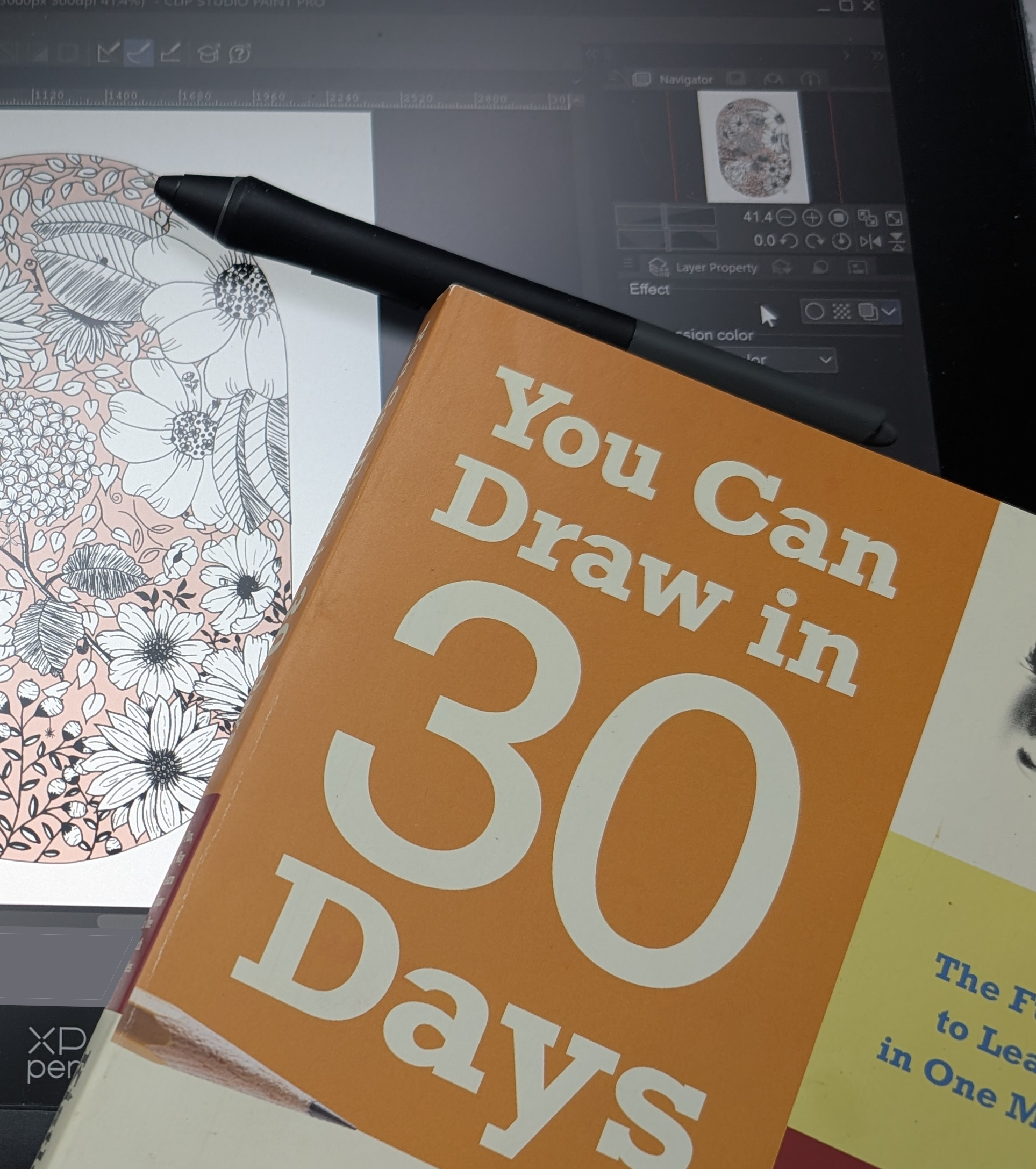
While there are shelves full of “how-to” guides, the one that truly resonated with me was You Can Draw in 30 Days by Mark Kistler, this wasn’t chosen lightly. I sifted through a mountain of information online—from blogs to YouTube reviews, and this title kept rising to the top. Deciding to take the plunge, I purchase it, and I am so thankful I did.
Why “You Can Draw in 30 Days” Works
Mark Kistler has a very direct approach: no fluff, just proven scientific methods. He gets right to the point, proving his theory that drawing is a mechanical skill. He doesn’t make you draw with your eyes closed or spend endless hours drawing lines and boxes. At 55, I wanted to draw something now, not in years.
Mr. Kistler teaches “The Nine Fundamental Laws of Drawing.” These nine laws, not some magical talent, teach you to create the “illusion of depth.” These laws prove that drawing is a learnable skill, just like driving or cooking.
The Nine Fundamental Laws:
- Foreshortening
- Placement
- Size
- Overlapping
- Shading
- Shadow
- Contour lines
- Horizon line
- Density
You don’t need to memorize these now. You just need to know they exist—and that they’re learnable.
Why This Book Works for Adult Learners
While the book is titled “30 Days,” we all know life happens. Sometimes, it takes a bit longer. That is okay. My own drawing journey took longer than a month, but I persevered.
What makes this book perfect for adult learners:
- No artistic jargon – Clear, simple instructions
- Step-by-step progression – Each lesson builds on the last
- Scientific approach – Appeals to logical thinkers
- Quick results – You create recognizable drawings from Day 1
- No expensive supplies needed – Just a pencil and paper
Below, you will find the pictures from my journey, proof that if you keep going, the skill will come.
My Drawing Journey: Proof It Works
Day 1: The Starting Line
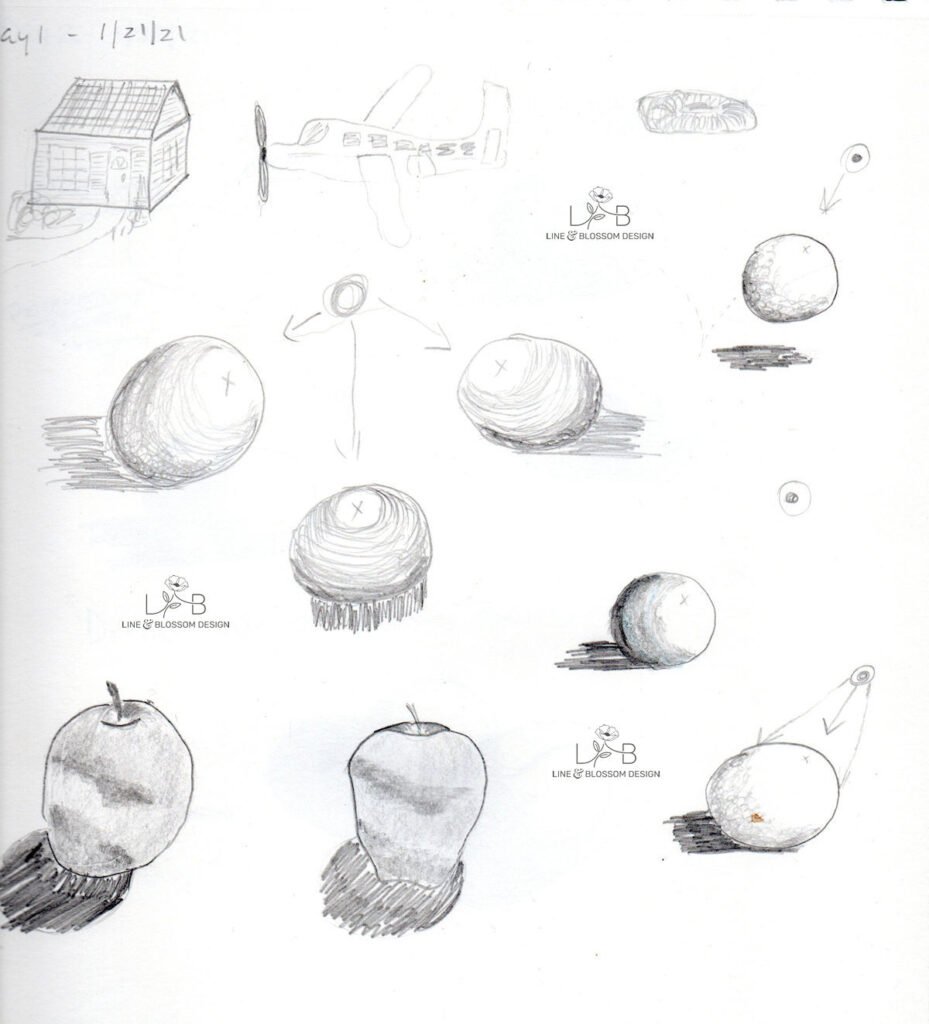
In January of 2021, I decided I was going to learn how to draw. This page shows exactly where I started. Take a close look at the house, the airplane, and… whatever that third thing is (I have no clue!) at the top of the page. These are “symbol drawings”—flat and childlike.
This is what 50 years of believing I had “no talent” looked like, even though I tried very hard to make them look as great as possible. But look at the bottom of the page. You can see the struggle as I tried to apply the first lesson on shading. It wasn’t perfect, but for the first time in my life, I wasn’t just drawing a circle; I was trying to create a sphere. Looking at the image above you can clearly see beginner drawing progress and how I was learning to shade.
During that very first lesson, I began to understand why my airplane looked so weird.
The realization: I had been drawing simple basic shapes instead of observing reality and applying the laws of depth. In my defense, a person can’t apply any of the drawing fundamentals if they do not know they exist.
Day 9: Progress in Action
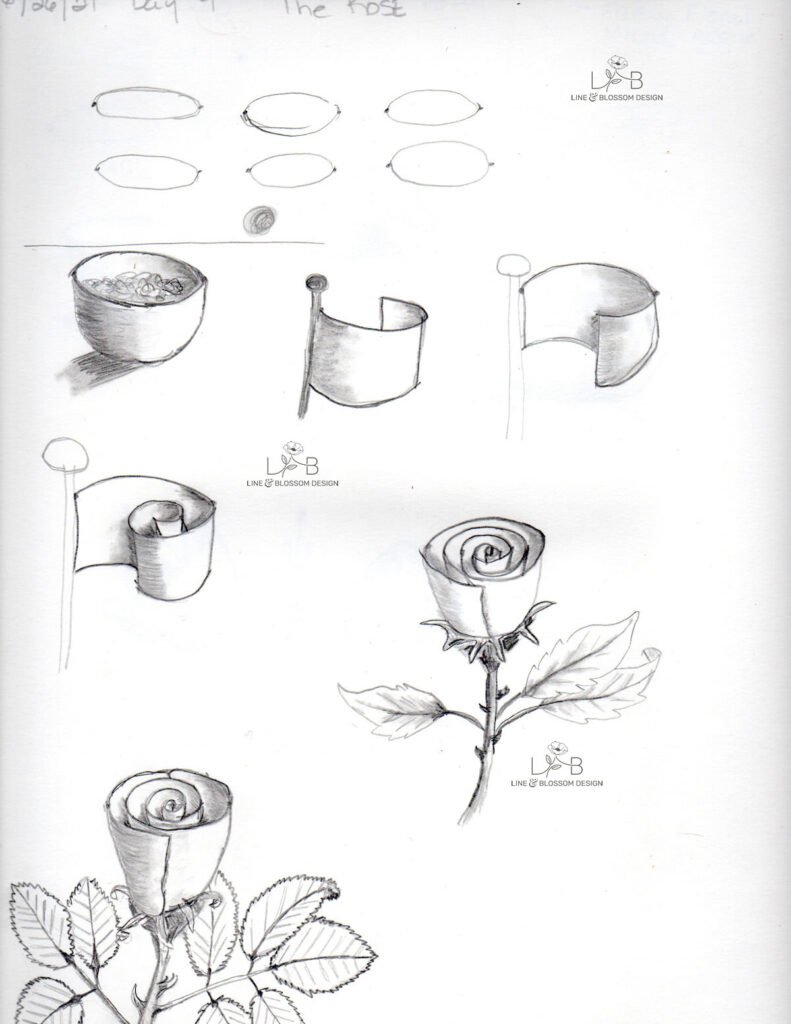
Let’s now fast forward to June of 2021. Unlike that “third whatever” on Day 1, anyone can tell what I was drawing here.
Learning isn’t magic; it’s construction. The image above demonstrates that construction method drawing works. This lesson taught me that a complex object like a rose isn’t drawn by “feeling” or “imagining” the flower. It is built using cylinders, flags, and shading. This is a geometric approach to drawing. Once I understood the structure, breaking down something as complex as a rose into the basic shapes it contained—the drawing simply appeared on the paper.
Drawing this modernistic rose was an amazing moment for me. I really started to put together in my own head how shadowing could make such a big difference.
The lesson: Complex objects are just simple shapes combined with proper shading. No talent required, just knowledge of the technique.
The Result: Five Months Later
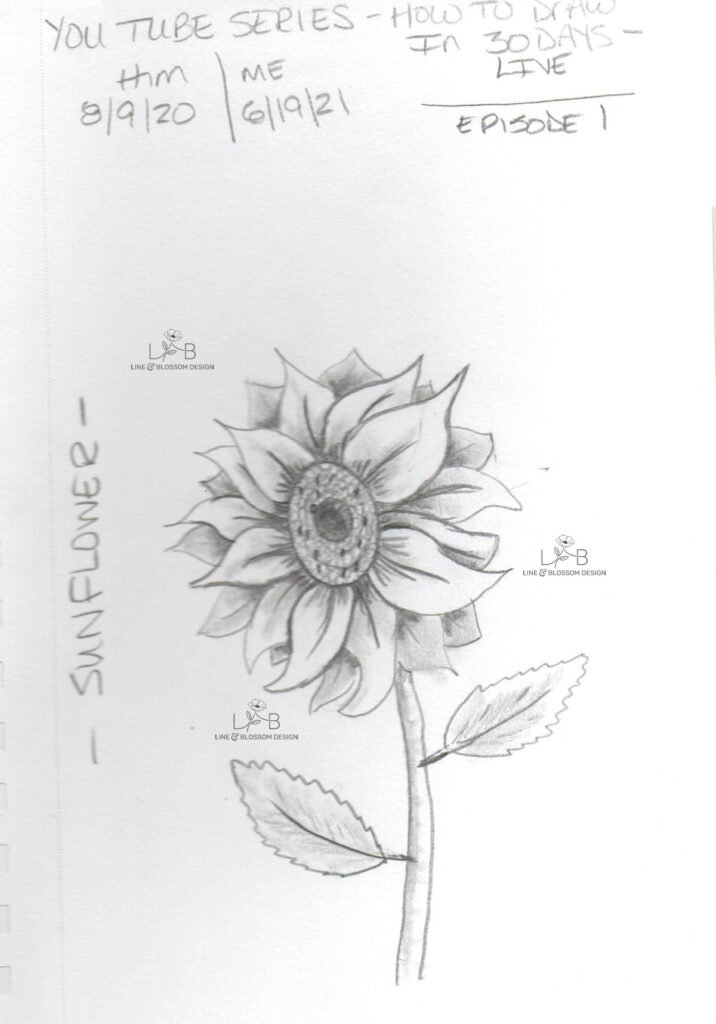
This sunflower drawing was also done in June of 2021. It was done by the same hand that drew the flat airplane just five months earlier.
I drew this while following along with Mark Kistler’s “How to Draw in 30 Days” Live series on YouTube. Watching the process in real-time helped me see that art isn’t magic—it’s just a series of steps. I didn’t get a talent transplant; I just learned the rules of texture and light.
In five months I progressed from beginner to advanced. The drawing transformation between Day 1 and my sunflower was mind blowing for me.
I clearly remember showing this finished drawing to my husband, over the moon excited and happy about what I had accomplished. This is the difference between believing in talent and believing in skill.
The Science Behind Why This Works
Drawing is a Mechanical Skill
Your brain can learn to:
- Judge distances and proportions (placement, size)
- Understand light and shadow (shading, shadow)
- Perceive depth (overlapping, foreshortening)
- Translate 3D to 2D (all nine laws combined)
None of this requires “talent.” It requires:
- Instruction – Someone to show you the rules
- Practice – Repetition to build muscle memory
- Patience – Time to develop the skill
That’s it. No magic required.
Why Adult Learners Have an Advantage
Adults actually have several advantages over children when learning to draw:
- Better focus – You can sit still for a lesson
- Logical thinking – You understand “why” things work
- Motivation – You chose to learn (not forced)
- Life experience – You’ve observed the world for decades
- Discipline – You can commit to practice
The only disadvantage? The belief that you’re “too old” or “have no talent.” Both are lies.
Don’t Wait Until You’re 55 Like I Did
After decades of self-doubt due to my family convincing me I had no talent, one book started me on a path of discovery and fulfillment.
If you have a pencil and a piece of paper, you have everything you need to start. You don’t need expensive supplies, and you certainly don’t need permission from a “gatekeeper” to call yourself an artist.
The best time to start was yesterday; the second-best time is right now.
Whether you’re:
- 25 and think you’re “not creative”
- 45 and wish you’d learned as a kid
- 55 like I was and think it’s “too late”
- 75+ and want to try something new
You can learn to draw at any age. The only question is: Will you pick up the pencil?
Your Next Step: How to Start Drawing Today
Option 1: Start for Free (Right Now)
What you need:
- Any pencil (even a #2 school pencil)
- Any paper (printer paper, notebook, even junk mail)
- You Can Draw in 30 Days borrowed from your library (FREE)
Time commitment: 20-30 minutes per day
Result: Noticeable improvement in days, dramatic transformation in weeks
Option 2: Invest in Your Journey ($5-8)
What you need:
- Basic mechanical pencil ($3)
- Simple sketchbook ($5)
- The book (library or purchase)
See my complete supply guide for beginners
Option 3: Follow Along Online (Free)
Can’t get the book right away? Search YouTube for “Mark Kistler”, go to his YouTube page and you’ll find several options, including “Can Professor Bill Learn-To-Draw in 30-Days?” series, which covers the first 13 days of lessons from his book.
Pro tip: Even if you watch on YouTube, I still recommend getting the book. Having the physical book to reference and practice with makes a huge difference.
My Complete Recommendation for Beginners
The Book: You Can Draw in 30 Days by Mark Kistler
Where to get it:
- Library – Check it out for free (my recommendation to start)
- Amazon – New or used physical book or e-book
- Barnes & Noble – Physical book or e-book
- Used bookstores – Often available at significant discount
Cost: FREE (library) or $15-20 (purchase)
The Basics: A Standard Pencil and Paper
Note: A regular or mechanical #2 pencil works perfectly—just grab a piece of paper -printer, copy, school.
That is really all you need to start. However, if you want to know exactly which pencils I use to get deep shadows, or the specific tool I use to keep graphite off my hands (I hate the mess!), I wrote a separate guide for you.
What Happens After You Learn to Draw?
Learning to draw opened doors I never expected:
I discovered my artistic style through a process I call “subtraction”—eliminating what I hated until only what I loved remained. Read about finding your style.
I learned about my brain and discovered I have aphantasia (inability to visualize mental images), which explained decades of confusion about “creative visualization.”
I built a business selling my botanical line art at Line & Blossom Design—it all started with a $3 pencil and a $5 sketchbook.
None of this would have happened if I’d kept believing the Talent Myth.
Common Questions About Learning to Draw as an Adult
“Am I too old to learn?”
No. I started at 55. I’ve heard from readers who started at 60, 70, even 80+. Your age is not a barrier—your belief is. You can learn to draw at any age.
“Do I need natural talent?”
No. Drawing is a skill, not a talent. If you can learn to drive a car or use a computer, you can learn to draw.
“How long does it really take?”
Mark’s book says 30 days. For me, it took about 5 months to go from Day 1 to the sunflower. Everyone progresses at their own pace. The question isn’t “how long?” but “are you willing to practice?”
“What if my drawings still look bad after practice?”
They won’t. If you follow the instructions and practice consistently, you WILL improve. It’s not magic—it’s mechanical. Your hand learns the motions, your eye learns to see, your brain learns the rules.
“Can I learn without taking a class?”
Yes! I learned entirely from Mark Kistler’s book and YouTube videos. No formal classes, no art school, no instructor. Just the book, practice, and persistence.
The Truth About Talent
Here’s what I learned at 55 that I wish I’d known at 5:
“Talent” is just skill you can’t see being built.
When you see someone draw beautifully, you’re not seeing talent—you’re seeing hundreds of hours of practice that happened before you arrived. You’re seeing learned skills that look effortless because they’ve been repeated so many times.
Every artist you admire:
- Started not knowing how to draw
- Practiced (probably for years)
- Made terrible drawings along the way
- Learned techniques and rules
- Built the skill through repetition
The only difference between them and you? They picked up the pencil and started.
| The Talent Myth says… | The Mechanical Reality is… |
| “You must be born with it.” | Anyone can learn it with instruction. |
| “It is a magical gift.” | It is physics and optics (light & shadow). |
| “You can’t learn after childhood.” | Adults have better focus and discipline. |
| “Good art just ‘happens’.” | Good art is constructed using shapes. |
Your Assignment (If You Choose to Accept It)
- Today: Get a pencil and paper (whatever you have)
- This week: Reserve or purchase You Can Draw in 30 Days
- Day 1: Follow the first lesson
- Every day for 30 days: Practice for 20-30 minutes. Even if you need to repeat lessons.
That’s it. Just show up, follow the instructions, and practice.
30 days from now, you could:
- Draw recognizable objects with depth and shadow
- Create drawings you’re proud to show others
- Have proof that drawing is a skill, not a talent
- Be on your way to whatever creative path calls to you
Or, you could still be telling yourself you “have no talent.”
The choice is yours. The pencil is waiting.
Now, Go Pick Up Your Pencil
That is it. No magic required. Just instructions.
You don’t need talent. You don’t need expensive supplies. You don’t need to be young. All of these are part of the Talent Myth and I promise this myth is a lie. I proved it to myself and you can too. It’s never to late, you can learn to draw at any age!
You just need to decide that the Talent Myth ends today.
A Quick Note
As you start your own drawing journey, please remember to date everything you draw. You will thank me in a year, 2 years, or like I am showing you here, 5 years later. Over the years I have been able to clearly see the progress I made, and that is invaluable. Knowing where you started and seeing for yourself the improvements you have achieved through learning and practice is one of the best things to keep you inspired and moving forward.
Prove It For Yourself
Go to Mark Kistlers YouTube Video for Professor Bob’s Day 1 tutorial, grab a pencil and piece of paper, follow along. You will prove to yourself the Talent Myth is a lie and drawing is a skill.
I’ll be here to guide you through the journey:
Read Next: Best Drawing Supplies for Beginners: Complete Guide Under $20
Share your Day 1 drawings in the comments below! I showed you mine, now show me yours. Let’s prove together that drawing is a skill anyone can learn.
