Introducing 22oz Copper Insulated Water Bottles! Cold for 48 hours & Hot for 12. In the SHOP Now

Choosing Paper for Beginners: Cutting Through the Confusion
Choosing paper feels overwhelming with so many types, weights, and terms to sort through. This guide breaks down tooth, lbs versus gsm, and more. It includes a reference table listing various paper types alongside some of the mediums that work well with each.
 ByLeona

I promise you, this is the most controversial topic in the art world, regardless of medium. Most artists, and manufacturers for that matter, have very strong opinions about choosing papers. AND everyone thinks they are right. With that said, the paper you choose has a much bigger impact on your finished art than the actual medium you used to create it.
At Blick Art Materials under the Papers & Boards category there are 19 different types you can choose from with each one having multiple brands and options available. These papers are for multiple medium types, but often cross over to other mediums. It is a veritable smorgasbord of choices, which is exactly why choosing paper feels so overwhelming at first. This post hopes to take away the confusion around choosing paper and give you the general knowledge you need when looking at what is out there.
First off, I want to make clear if you can only afford bargain bin paper to create your art it is fine and there is nothing wrong with this. Having the desire to draw or paint is not exclusive to those with bigger budgets and someone who has a tight one should never be condemned or made to feel inferior because of it.
The Terms You Need to Know
There are a few terms you are going to see when choosing paper. Some of these apply to all types such as pounds (lbs) and gsm (grams per square meter). When you get into papers that are specific to a medium like drawing (tooth); watercolor painting (rag, pulp, 100% cotton, cold, hot, & rough press), all of this together can get a bit confusing. I will tackle these one at a time, starting with the most common, pounds and gsm.
Pounds and GSM
When you look at a label on paper it will tell you the size, number of sheets, and the lbs / gsm. Size and number of sheets are self explanatory so I won’t discuss those, but lbs / gsm is a different story. What do these mean and why are they important to you?
Pounds (lbs) is an imperial measurement still used in the United States, even though most of the world has switched to metric. If you thought that the lbs number on paper meant how much it weighed you would be mostly right. It is the weight of a ream of that paper. The thing is the weight you see on paper A may not be determined the same way as paper B, confused yet?
As a reminder, a ream of paper is traditionally 500 sheets of paper. You might be wondering if a ream is a ream, then why isn’t the weight determined in the same way? Don’t worry this was very confusing to me too at first. This American system is based on the weight of a ream of paper at its basic uncut sheet size, which varies by paper type. The thing is all of the paper sizes are based on the printing industry, not art. Some examples are:
- Bond/Writing paper: 17 inches by 22 inches
- Text/Offset/Book paper: 25 inches by 38 inches
- Cover stock: 20 inches by 26 inches
- Bristol: 22.5 inches by 28.5 inches
- Index: 30.5 by 25.5 inches
- Tag: 24 x 36 inches
Art papers like sketch pads, drawing paper, and watercolor paper don’t always cleanly map onto these printing industry categories. Many art paper manufacturers use their own basic uncut sheet size and this may or may not be standardized.
What does all of this mean to you? Two papers can both say 80lb right on the label and feel nothing alike in your hands. An 80lb Text paper is light and flexible, similar to a magazine page. An 80lb Cover paper is a heavy cardstock. Same number, completely different paper.
Why? The 80lb rating for Text comes from weighing 500 sheets of the large 25×38 inch basis sheets. The 80lb rating for Cover comes from weighing 500 sheets of the much smaller 20×26 inch basis sheets. Since Cover starts from a smaller sheet, it takes a much thicker, denser paper to reach that same 80lb number.
This is exactly why so many artists tell you to ignore lbs entirely and focus on gsm instead. So, what is gsm?
GSM, grams per square meter, is the international metric system and is more consistent across paper types since it’s a direct measurement rather than a ream-based calculation. In other words, GSM doesn’t have the problem the American system does since it’s always grams per square meter regardless of paper category.
I imagine you are wondering, okay, but why does this matter? Heavier weight, using gsm, generally means the paper can handle more layers of medium, more erasing, more water in the case of wet mediums, without warping, pilling, or tearing through.
Tooth
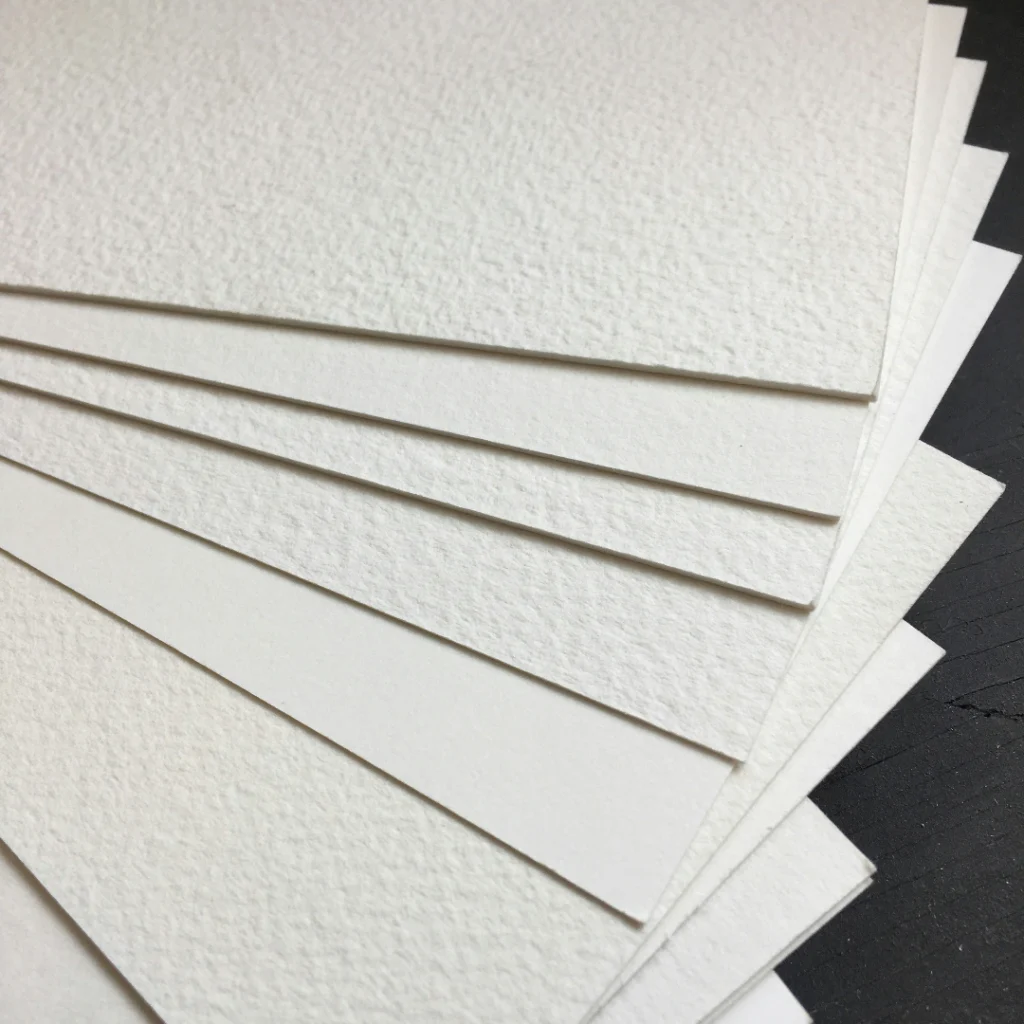
Now it is time to look at some of the more medium specific terminology. The first one I listed at the beginning was tooth. I applied it to drawing, but the thing is every medium specific paper has its own version of tooth. What is tooth? Tooth is essentially a way of describing how the surface interacts with and holds the medium. When you look and feel the papers the tooth is the texture or lack thereof.
If you are talking about drawing, be it with graphite, charcoal, or colored pencils, the term tooth is used. If you are talking about sanded paper for pastels it is referred to as grit. Watercolor papers use the term press; hot has less tooth than cold which has less tooth than rough. Bristol paper uses the terms smooth and vellum, the latter having more tooth.
Rag and 100% Cotton
The next terms are rag and 100% cotton. The reason these are listed together is they are names for the same thing, specifically what the paper is made from, cotton. The terms “rag” and “cotton” are often used interchangeably, though rag specifically refers to papers made with cotton textile remnants. As I am sure you guessed by now 100% cotton is made with all cotton.
The reason this is important is cotton holds up better to water and repeated work without breaking down, unlike wood pulp. You will rarely see wood pulp advertised on papers because it is a standard ingredient. Cotton or rag is advertised because it out performs wood pulp hands down.
Archival and Acid Free
Another term you will see a lot is archival or acid free. You will find the phrase archival paper in every print listed in the Line & Blossom Design shop. Acid is often a natural byproduct of how paper is made, and it causes yellowing and breakdown over time. Archival paper is acid free and will stay the same even after decades. It still should be kept out of direct sunlight though.
Sizing
The next term, sizing. Sizing controls how much liquid paper absorbs. Without it, you may end up painting on a roll of paper towels. Watercolor paint would bleed everywhere uncontrollably. More sizing means crisper edges and more control. Less sizing means softer, more diffused results. It can be applied either in the paper or on the paper. Sizing matters most for wet mediums like watercolor.
Vellum
And lastly, the most confusing term of all, vellum. I already used this term when talking about bristol paper and its tooth. As a reminder, bristol vellum has more tooth than smooth. So what makes this term so confusing? It is also something completely different and unrelated to tooth. Vellum is also the name of a translucent paper used for tracing and technical drawing.
Same term is used but very differently. One is used as a description of texture on papers, the other is see-through. What brainiac decided to do this? In a nutshell, two different people trying to get rich off the same antiquated term.
If you are wondering exactly how one word ended up meaning two unrelated things, blame history. Vellum originally had nothing to do with paper at all. It was a writing material made from calfskin, used for centuries before paper existed. When paper eventually replaced it, manufacturers wanted to capture some of that same quality. One version chased the translucent look of the original calfskin and became tracing paper. Another version chased the smooth, premium feel and became a textured Bristol finish. Neither has anything to do with the other, they just both borrowed the same old name.
Paper Types at a Glance
Now that you understand the terms, choosing paper becomes much easier. Below is a list of papers, their range of weights and some of the medium you can use on them. I also included beginner notes and warnings. While I have bought and used more paper types then I care to admit, I have not used them all. I am sure many wonderful papers have been omitted from this table.
If you are an artist and know a paper that is ideal for a certain medium, please post in the comments; the medium, the paper and a reason why it works as well as any notes or warning people should know. Also if there is a paper listed that works with another medium that is not in the primary mediums column, post that in the comments as well. I will do my best to update this table as needed.
| Paper Type | Most Commonly Used Weight | Primary Mediums | Beginner Note Warning |
| Sketch | 50–70 lb 80–115 gsm | Charcoal Colored Pencil* Fine-liners Drawing Pens Graphite | Best for quick thumbnails, practice, and ideation. Thinner paper will pill with heavy erasing or bleed with wet media. *only light application. |
| Drawing | 70–90 lb 115–150 gsm | Charcoal Colored Pencil Graphite Fine-liners Drawing Pens Oil Pastel | Has a distinct “tooth” to grab and hold dry pigment layers. Handles erasing well without tearing. |
| Bristol Smooth | 100 lb 270 gsm | Alcohol Markers Fine-liners Drawing Pens Water-based Markers | Little to no tooth. Nibs glide seamlessly for razor-sharp lines without feathering. Works well for water-based markers if you avoid heavy, wet blending layers. |
| Bristol Vellum | 100 lb 270 gsm | Charcoal Colored Pencil Graphite Hard Pastels Watercolor Pencils Water-based Markers | “Vellum” here refers to texture. It has a micro-tooth that acts like a hook for blending dry media. Note: Can handle watercolor pencils and water-based markers if you use a very light hand with water. |
| Colored Pencil Paper | 90–100 lb 150–270 gsm | Fine-liners Drawing Pens Graphite | Warning: Despite the name, it is often too slick to hold multiple layers of colored pencil! Excellent for crisp pen work instead. |
| Marker Paper | 18–50 lb 70–75 gsm | Alcohol Markers | Intentionally very thin, but treated on the back to stop bleed-through. Prevents paper from soaking up and wasting expensive marker ink. Not recommended for water-based markers as they can pool or smear. |
| Blending Cardstock | 80–110 lb 250–300 gsm | Alcohol Markers Fine-liners Drawing Pens | Heavy-duty, smooth cardstock. Engineered to withstand heavy alcohol marker blending without pilling or fraying. |
| Synthetic Paper | 74–144 lb 200–390 gsm | Alcohol Inks Alcohol Markers | 100% plastic and completely waterproof. Inks sit entirely on top to create beautiful, fluid, vibrant edges. |
| Watercolor Hot Press | 90–300 lb 190–640 gsm | Gouache Pen-and-Wash Watercolor Watercolor Pencils Water-based Markers | Pressed with hot rollers to stay smooth while retaining absorption. Fantastic for watercolor pencils and water-based markers because you can draw crisp, sharp details before dissolving them seamlessly with a wet brush. |
| Watercolor Cold Press | 90–300 lb 190–640 gsm | Gouache Watercolor Watercolor Pencils Water-based Markers | The universal standard for beginners. Visible texture allows water to pool beautifully. For watercolor pencils, the bumps catch a lot of dry pigment, leading to rich, vibrant washes when activated. |
| Watercolor Rough | 140–300 lb 300–640 gsm | Watercolor Heavy Fluid Media | Has the most pronounced texture of all. Pigments settle deep into the valleys for dramatic visual effects. Can be tough to draw fine pencil or marker details on due to the deep texture. |
| Pastel Paper (Traditional) | 98 lb 160 gsm | Charcoal Hard Pastels Pastel Pencils | Relies on a manufactured texture (like a grid or honeycomb) to hold pigment. Has a strict limit on how many layers you can apply before it fills up. |
| Sanded Pastel Paper | Varies by Grit / Heavy Card | Charcoal Colored Pencils PanPastels Pastel Pencils Soft Pastels | Texture is referred to as “grit”. The abrasive coating physically bites into the medium. Phenomenal for colored pencils when you want to build up heavy, solid, painterly layers without the paper peeking through. |
| Cardstock (Craft) | 65–110 lb 175–300 gsm | Fine-liners Drawing Pens Graphite | Budget Choice: Highly accessible and excellent for clean line art. Warning: Lacks “tooth” for heavy pencil layering and has no “sizing” for water. It will absorb marker ink heavily and warp instantly with watercolors. |
Why Brands Matter More Than You’d Think
I have explained many of the terms associated with choosing paper and given you a list of different papers and some of the mediums that perform best on them, now for the most controversial topic of them all, brands. Among artist there is an almost cult like preference for brand A over brand B. The reason for this, as you will discover, is personal preference.
Every manufacturer of any paper has their own proprietary method for making that paper. These methods create a lot of variation in that particular type of paper. With that said, remember different brands will perform differently and the tooth or texture of the paper can vary wildly.
As an example, watercolor paper comes in three press types; hot, cold, and rough. Brand A’s cold press could be closer to hot press or rough of brand B. This is not only true for papers of the same quality, but also all price points.
A budget paper of any type is not going to perform as well as the high quality one. Most all artist tutorials tell you to buy the best you can afford. While this is true for the most part, who wants to spend loads of money on a paper for practice? Sketch paper is amazing for practice for several mediums, but if you are practicing with markers, paint, or pastels you can forget using it.
This is where as an artist you must make the choice. There is always a budget friendly option, you just have to find it. Using the watercolor paper again as an example, many artists swear by Canson for practice. I personally hated it. The limitations due to its budget friendly nature fought me constantly, but this was due to my style of painting and not because of its price point.
The Table Isn’t the Rulebook
As you can see in the table some papers have a list of mediums that work well with it. The thing is this is not exclusionary. Just because a medium isn’t in that list doesn’t mean it won’t work, but it also means it may not. Experimentation is the only way to know. Take Colored Pencil Paper for example; it is horrible for colored pencils, but amazing for fine-liners.
Frequently Asked Questions
Why is choosing paper so confusing?
Because so many manufacturers use different systems, terms, and marketing claims, and even experienced artists disagree on what’s actually best. The good news is the confusion fades as you learn your chosen medium and what actually matters for it and your style.
What’s the single most important paper to buy first?
A sketchbook or sketch pad with no visible sheen. That single purchase covers practice for almost every medium you might try and won’t fight you while you’re learning.
Can I use the wrong paper and still get good results?
Sometimes. Pairing the wrong paper with a medium could fight you or not work at all. But as colored pencil paper proves, sometimes you will make a great discovery. Sorry, but this really is a mixed bag and one never knows for sure.
Do I need different paper for every single medium I try?
No, but you’ll get better results with the right paper. Sketch paper and drawing paper cross over for several dry mediums. Wet mediums like watercolor and heavy alcohol markers are where paper choice matters most.
I’m on a tight budget, what should I do?
Buy what you can afford, period. A cheap sketchbook with decent tooth (no sheen) beats no sketchbook at all. As your budget allows, you can upgrade. The most important thing is to create art!
Do I need to buy expensive paper to get good results?
No. While those high-end papers exist for a reason, you can create great art on budget friendly papers. The best paper is sometimes what you can afford and will actually use.
I know this was a lot of information to take in, but hopefully choosing paper feels less overwhelming now that you understand the papers types available to you as well as what some of those terms you come across actually mean. I will get into more details about the various papers in their medium specific posts.
Choosing Paper for any medium is confusing and overwhelming when you are just starting out. Believe me, every artist has had this struggle. How a paper reacts to your medium, your method, and your style is different for everyone. So don’t feel bad if tutorials tell you to use brand A and you hate it.
