Introducing 22oz Copper Insulated Water Bottles! Cold for 48 hours & Hot for 12. In the SHOP Now

Drawing with Aphantasia: How I Create Art Without Mental Images
Most artists close their eyes and see what they want to draw. I close my eyes and see nothing. Absolutely nothing. This is how I create botanical art with a completely blank mind's eye.
 ByLeona

Can you draw if you can’t visualize images in your mind?
For 59 years, I didn’t even know this was unusual. I thought “picture this” was a figure of speech. I thought everyone experienced the world the way I did.
I was wrong.
I have aphantasia, the inability to create mental images. I have no mind’s eye. And it explains decades of confusion about visualization, imagination, and creativity.
This is why I struggled with painting from imagination, why “visualize your happy place” meditation never worked, and why I finally flourished with structure-based drawing.
But here is the good news: You don’t need a “mind’s eye” to be an artist. You just need a different set of tools.
What is Aphantasia? When “Picture This” Isn’t Possible
I eventually discovered I have a condition so relatively new to the public consciousness that my word processing software still underlines it in angry red ink: Aphantasia.
If you haven’t heard of it, don’t worry, less than a year ago, I hadn’t either. My discovery came about by sheer chance when I clicked and read an article in one of my feeds.
The Moment I Realized I Was Different
For my entire life, I assumed that when people said “picture this” or talked about their “mind’s eye,” they were being poetic. I thought it was a figure of speech.
I didn’t know that when you close your eyes and count sheep, you are actually supposed to see sheep. Believe me, the idea of closing my eyes and seeing sheep freaks me out because I was born this way. A future post expands upon this concept.
I see nothing. My mind is a blank screen. Just like you turned the lights off in a room.
Finding this out was a shock, but it was also a revelation. Suddenly, decades of confusion started to make sense.
What is Aphantasia? A Quick Explanation
Aphantasia is the inability to create mental images.
When most people close their eyes and think of a beach, they “see” waves, sand, maybe a sunset.
When I close my eyes and think of a beach, I see… nothing. Just darkness.
According to research, approximately 2-5% of the population has aphantasia, though many people go their entire lives without knowing they have it (like I did for 59 years).
For artists, this creates a unique challenge: How do you create images on paper when you can’t create them in your mind?
The Science of Aphantasia (It’s Real, and You’re Not Alone)
Aphantasia was formally identified and named by Professor Adam Zeman in 2015. While the condition has likely existed throughout human history, it’s only recently been studied scientifically.
Interesting facts:
- Many successful professionals have aphantasia, including artists, designers, and creative professionals
- It’s not a disorder or disability, it’s a difference in how the brain processes information
- Some people have the opposite: hyperphantasia (extremely vivid mental imagery)
If you suspect you have aphantasia, there are online tests available (search “VVIQ test” – Vividness of Visual Imagery Questionnaire).
Signs You Might Have Aphantasia
Do any of these sound familiar?
- You thought “count sheep” was just a figure of speech
- You can’t picture your loved ones’ faces when they’re not present
- “Visualize your happy place” meditation doesn’t work for you
- You describe scenes in detailed words rather than pictures
- You’re confused when people say “I can see it in my mind”
- You rely heavily on reference photos for any creative work
- Memory feels more like “knowing facts” than “replaying movies”
- You can’t mentally rotate objects or preview how furniture would look in a room
If you nodded along to most of these, you might have aphantasia.
How My Aphantasia Brain Works: Data Instead of Images
My brain runs on data, not pixels.
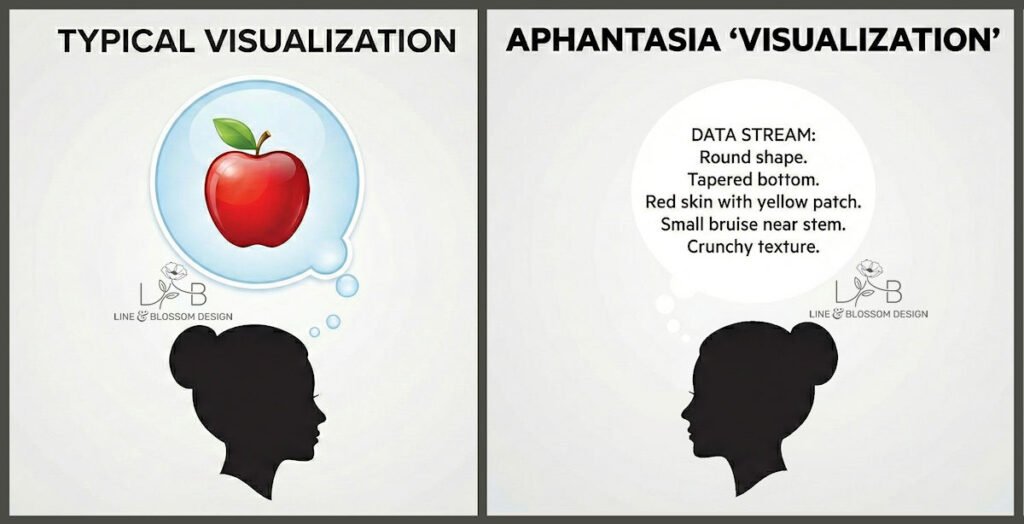
Typical Visualization vs. Aphantasia
The comparison image above accurately explains what happens in my mind. The old saying “A picture is worth a thousand words” probably hit closer to home for me than most. My brain is constantly going, some days it seems nonstop.
My mind narrates the world in detailed descriptions because it can’t photograph it.
I don’t think in pictures; I think in paragraphs.
This isn’t a disadvantage, it’s just a different operating system so to speak.
How Typical Artists Create vs. How I Create
| The Visualizer’s Brain | My Aphantasia Brain |
| Visualize the finished piece mentally before starting | Build pieces step-by-step without seeing the end result |
| “See” the composition in their mind | Rely on reference images and structural rules |
| Can mentally rotate and manipulate images | Use logic and data instead of mental images |
| Paint or draw from imagination or memory | Create through construction, not visualization |
| Have to “unlearn” mental symbols to draw reality | Never had mental symbols to fight against (advantage!) |
Neither approach is better—they’re just different. And understanding this difference changed everything for me.
How Aphantasia Affected My Art Journey
Why I Couldn’t Paint Like Bob Ross
I grew up watching The Joy of Painting. Bob Ross would close his eyes, visualize a mountain scene, and paint it from imagination.
I tried. And failed. Repeatedly.
Now I know why: Bob Ross could see those “happy little trees” in his mind and transfer them to canvas. I couldn’t see anything to transfer.
His entire method relies on the one thing my brain can’t do—visualize a scene and paint it from imagination.
Why “Draw What You See” Never Made Sense
This data-driven approach explains why standard art advice always felt like a riddle to me.
I remember reading the golden rule of drawing: “Draw what you see, not what you think you see.”
For most artists, this is profound advice. Their brains are constantly offering them “symbols” instead of reality. They look at a tree, but their mind’s eye flashes a generic, elementary-school “lollipop” tree. They have to fight against that mental image to draw the complex, messy reality in front of them. They have to learn to replace those symbols.
But I didn’t know that.
I was confused by the advice because I didn’t have the “symbol” in my head to fight against. When I looked at a tree, I didn’t see a mental cartoon; I just saw the tree. When I started learning to draw I had difficulty understanding what many drawing tutorials were explaining and the methods they suggested beginners use.
The Aphantasia Advantage: No Symbols to Unlearn
For years, I thought everyone learned to draw the same way I did—by looking at the actual object. I didn’t realize that most artists have an internal battle I never experienced.
Typical artists have to UNLEARN their mental symbols. They have to stop drawing the “idea” of a tree and start drawing the actual tree in front of them.
I never had that problem because I never had those symbols. In some ways, aphantasia gave me a head start: I was forced to observe reality from day one because I had no mental image to fall back on.
But this same condition is why I couldn’t paint landscapes from imagination. I couldn’t “see” anything to transfer. I could only paint from following step by step tutorials or paint along with me videos.
Why Structure-Based Drawing Works Perfectly for Aphantasia
After struggling with painting, I switched to learning how to draw using Mark Kistler’s You Can Draw in 30 Days.
And suddenly, everything clicked.
Drawing in the Dark: Building Instead of Visualizing
For Line & Blossom Design, I don’t “dream up” an image. I build it.
Because I can’t visualize the final result perfectly before I start, every piece is a journey of discovery for me, too. I rely on the logic of lines and the structure of shapes—the data, with a bit of intuition and imagination thrown in for good measure.
I don’t see the curve of a petal until my pen puts it there.
Why Line Art is Perfect for Aphantasia Artists
Line art doesn’t require you to hold a complex mental image. It’s sequential:
- Draw this curve
- Add this line
- Connect them here
- Build the next shape
Each line informs the next line. I’m not trying to match an image in my head; I’m following a logical progression of structure and shape.
For someone with aphantasia, this is liberating. I’m not “failing” to see the final image, I’m building it discovery-style, one line at a time.
The flower emerges on the page at the same moment it emerges in my understanding.
Why Structure-Based Methods Work
Mark Kistler’s approach to drawing is perfect for aphantasia brains because it’s based on laws and rules, not visualization: Namely The Nine Fundamental Laws of Drawing
These are mechanical, logical rules—not “feel it” or “imagine it” instructions.
I don’t need to visualize a sphere. I need to know the facts:
- Draw a circle
- Add shading on one side (where light doesn’t hit)
- Add shadow on the surface beneath it
- Result: The illusion of a 3D sphere
This is data, not visualization. And my brain excels at data.
How I Draw Today
Over time as I developed muscle memory, the need for starting with the outline of basic shape dwindled. I do still think about them, but I don’t need to physically draw them very often. I admit that when I am learning to draw a new flower, I go back to the basics I learned years ago following You Can Draw in 30 Days by Mark Kistler.
I break the subject I want to learn to draw down into its basic shapes and draw those exact shapes. I modify them until I have the final flower I was wanting. As I practice my brain creates its own version of a “mental image”.
My mental image is a detailed description that I perceive as that particular flower. As I draw something from memory I know if the line I put to paper, well now to screen, is correct, if it works. When I physically see something I draw my brain compares it the description and viola I know if it matches.
If You Have Aphantasia: How to Approach Learning Art
If you suspect you have aphantasia and want to create art, here’s what I’ve learned:
1. Stop Trying to Visualize
If “envision the finished piece” advice makes you feel broken, ignore it.
You don’t need to see it mentally to create it physically.
When instructors say “picture this in your mind,” translate it to: “understand the structure and build it step-by-step.”
2. Use References Religiously
While other artists might paint “from mental images,” you’ll work from references. That’s not cheating, it’s adapting to your brain’s strength. Using references to understand structure (like how a petal attaches to a stem) is learning. Copying another artist’s drawing line-for-line is theft. Use photos of real flowers to build your own unique art.
I keep a folder of flower reference photos, most are ones I took of my wildflowers and other are from my neighbors gardens. Some of these photos have been used on Line & Blossom Design, any photograph you see throughout this site is one I took.
I study the structure, break it down into components, and build my line art from observation and logic. I don’t try to perfectly draw a scientifically accurate picture. I capture the character of the flower, the way a petal droops or a stem twists. As I learn I begin to make the flower my own.
3. Embrace Structure-Based Art
| Focus on drawing methods that teach | Avoid methods that rely heavily on |
| Step-by-step construction | “Visualize the scene” |
| Geometric foundations | “Feel the emotion and let it flow” |
| Logical progressions | “Paint from your imagination” |
| Rule-based techniques | Memory-based drawing exercises |
You Can Draw in 30 Days by Mark Kistler is perfect (in my opinion), it’s all structure and rules, no “imagine this” vagueness.
4. Choose Mediums That Build Sequentially
| Consider: | Maybe avoid (or approach carefully) |
| Line art (my choice) | Loose, impressionistic painting |
| Technical drawing | Abstract expressionism (“paint what you feel”) |
| Geometric patterns | Painting from imagination |
| Architectural sketches | Portrait drawing from memory |
| Zentangle/mandala art | |
| Observational drawing from life |
5. Reframe “Lack of Visualization” as “Data-Driven Creation”
Your detailed, descriptive thinking is an asset.
You notice things other artists miss because you narrate the world in words. You observe carefully because you can’t fall back on mental shortcuts.
This makes you an excellent observational artist.
How Aphantasia Shaped Line & Blossom Design
Every piece in my shop is created the same way I’ve created art since before discovering my aphantasia: through structure, observation, and sequential building.
I don’t “dream up” a flower and transfer it to paper. I:
- Look at real flowers (or high-quality reference photos)
- Break them down into their structural components
- Build them line by line, shape by shape
- Let the drawing emerge as I work
The result? Art that feels organic with a touch of whimsy, because it’s what I physically see or imagine and how I choose to interpret, not idealized mental images.
If you’ve ever felt like you “couldn’t be creative” because you don’t visualize things clearly, my work is proof that you absolutely can. My art probably won’t hang in the Louvre Museum, The Metropolitan Museum of Art (NYC), or even the Columbus Museum of Art but I am proud of it none the less.
Your art just comes from a different place.
Common Questions About Aphantasia and Art
Can you be creative with aphantasia?
Absolutely. Creativity isn’t about the images in your head; it’s about what you create in the world.
Many successful artists, designers, authors, and creative professionals have aphantasia. They just use different creative processes than visualizers.
Do all artists visualize?
No. Estimates suggest 2-5% of people have aphantasia, including professional artists and designers.
You might be surprised how many successful artists create without strong mental imagery.
Should I still try painting if I have aphantasia?
If you want to! But understand that you will require reference images. Photo-realistic painting, observational painting, or reference-based work might be more satisfying than “painting from your mind.”
I tried painting and struggled. But other aphantasic artists love painting—they just work from references.
What art styles work best for aphantasia?
Structure-based styles tend to work better:
- Line art and ink drawing
- Technical/architectural drawing
- Geometric patterns and mandalas
- Observational sketching from life or photos
- Detailed botanical illustration
Abstract or impressionistic styles can work if you approach them through structure and technique rather than “feeling.”
Can aphantasia be “cured” or trained?
Aphantasia isn’t a disorder that needs curing, it’s a different way of processing information. Some research suggests visualization can be slightly improved with training, but most aphantasics remain aphantasic. And that’s okay.
Focus on working with your brain, not trying to change it.
Will I always need reference photos?
Probably, yes. Over time, your hand learns the shape of a rose even if your mind can’t see it. Muscle memory eventually replaces the need for constant reference checking. My hand knows what a petal feels like, even if my brain can’t picture it.
Even artists with strong visualization often use references to ensure accuracy. Don’t think of it as a limitation—think of it as being thorough.
Resources for Artists with Aphantasia
Communities:
- Aphantasia Network (aphantasia.com) – Research and community
- r/Aphantasia – Reddit community of 100k+ members
- Facebook Groups – Search “Aphantasia Support”
Tests:
- VVIQ Test (Vividness of Visual Imagery Questionnaire) – Free online
- Various aphantasia screening questionnaires
Recommended Art Resources for Aphantasia:
- “You Can Draw in 30 Days“ by Mark Kistler (structure-based)
- Technical drawing books (rule-based approaches)
- Botanical illustration guides (systematic methods)
Scientific Research:
- Search “Adam Zeman aphantasia research” for the latest studies
- Exeter University (UK) has ongoing aphantasia research
Your Turn: Creating with (or Without) Visualization
Whether you have aphantasia or not, the lesson is the same: Your brain’s differences aren’t disabilities—they’re design features.
If you suspect you have aphantasia:
1. Take the VVIQ test (search online – it’s free)
2. Join the aphantasia community on Reddit or Facebook
3. Try structure-based drawing methods
- Start with You Can Draw in 30 Days
- Focus on rules, not “feelings”
- Use references without guilt
4. Stop trying to “visualize” and start building
5. Find your medium through experimentation
- Try line art, technical drawing, geometric patterns
- See what feels natural to YOUR brain
If you don’t have aphantasia:
Now you understand why:
- Some students struggle with “visualize it” advice
- Reference photos aren’t “cheating” if used correctly
- Not everyone experiences creativity the same way
Consider: Your own mental imagery might be limiting you. Remember, I never had symbol-trees to unlearn!
We All Have Different Paths to Creativity
If you have ever felt “uncreative” because you can’t visualize things in your head, know that creativity isn’t about seeing pictures or movies playing in your mind.
Creativity is about what you put on the page, not what you “see” or “don’t see” in your mind’s eye.
I might be drawing in the dark, but that just makes the final image that much more of a beautiful surprise, well most of the time.
I discovered I have aphantasia at 59, 4 years after I learned to draw.
Both discoveries changed my life. One explained my past. The other created my future.
See the line art I create without mental images at Line & Blossom Design
Do you have aphantasia? Share your experience in the comments below! Let’s build awareness and community. You’re not alone, and you’re definitely not “broken.”
Previously: Post 4: What Bob Ross Didn’t Tell You: The Hidden Prerequisite to Painting
Read Next: Post 6: Why Counting Sheep is Creepy: My Life with a ‘Blind Mind’s Eye’
