Introducing 22oz Copper Insulated Water Bottles! Cold for 48 hours & Hot for 12. In the SHOP Now

Why Counting Sheep is Creepy: My Life with Aphantasia
Everyone knows the trick: close your eyes and picture something. Sheep jumping a fence. A beach. A loved one's face. I have never once been able to do that. This is what it is actually like to live with aphantasia.
 ByLeona

Understanding Aphantasia and How It Shapes My Art
In my last post, Drawing with Aphantasia: How I Create Art Without Mental Images, I revealed a secret I didn’t even know I was keeping for 59 years: I have a condition called aphantasia.
This means that when I close my eyes, I see black.
I can’t picture a beach. I can’t picture a red ball. I cannot picture the faces of my loved ones.
The other day, I was talking with someone about this, and they were deeply confused. I realized that if you have a “normal” brain, my reality sounds baffling. So, I want to answer the questions that came up during our chat to explain what it’s really like inside my head, and why it makes my art exactly what it is.
What is Aphantasia? Born with a “Blind Mind’s Eye”
First and foremost, I was born with aphantasia. For me, having a “blind mind’s eye” is normal. I honestly can’t begin to fathom actually seeing things when I close my eyes.
Aphantasia affects approximately 2-5% of the population, meaning most people can easily visualize images in their mind to some degree. When you ask someone to picture a sunset, they literally see colors and light behind their closed eyelids. For me, there’s only darkness.
In fact, the idea of “counting sheep” to fall asleep, and literally seeing fluffy animals jumping over a fence, is both scary and creepy to me. If I saw sheep in my room, I wouldn’t think “relaxed,” I would think “hallucination” or “Oh Crap, my brain has snapped”.
Through that conversation, I discovered the opposite is also true, people with a mind’s eye find my experience equally scary. The confusion from the person I was talking with was palpable. It was like I’d just told them the sky and grass had switched colors.
The Apple Visualization Test: How Aphantasia Works
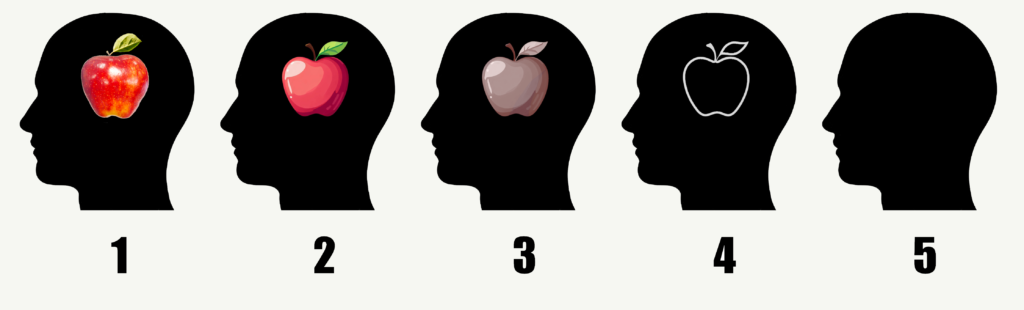
To understand my brain, they tried the standard aphantasia test. They asked me to close my eyes. The test I linked to is from the Aphantasia Network which is a great resource for those with aphantasia.
“Okay, picture an apple. What do you see?”
“Nothing. I see black. Like you turned off the lights.”
“You mean you don’t see an apple at all? Not even a faint one?”
“Nope. Just the back of my eyelids.”
“You really don’t see it?”
“No, I don’t.”
None of my responses made sense to them, which is understandable when you consider that roughly 95%–98% of the world’s population has some form of a mind’s eye. I am in the rare minority who lives in the dark, literally.
This simple test is often used to diagnose aphantasia. Most people can visualize an apple with varying degrees of clarity, from photographic detail to a hazy outline. People with aphantasia see nothing at all. There’s no dim image, no faded picture, just black.
The Disconnect: Hands vs. Brain When Learning to Draw
For years, I felt a disconnect between my hands and my brain, but until I learned about aphantasia last year, I didn’t know the cause.
When I want to learn something new, I turn to books or YouTube. As I take in the details, my brain assumes I can do it. This is especially true when I watch beginner drawing/painting tutorials. I understand the logic. I understand the steps. So, I pick up a paintbrush or a pencil and go at it, only for my brain to ask: Wait, what on earth is that?
This explains the tragedy of my Bob Ross Phase.
My Bob Ross Phase: When Painting Tutorials Don’t Work
I watched The Joy of Painting. I understood the mechanics of his “happy little trees.” Bob Ross made everything look effortless, and logically, my brain processed every step he demonstrated.
But here’s where aphantasia creates a unique challenge for learning to paint: when I tried to replicate what my brain logically understood, it didn’t occur to me to “hold” the image of the tree in my mind while I painted.
Most beginner artists can look at a reference, close their eyes, and still “see” the image while they work. They can visualize where the next branch should go or how the leaves should cluster. I couldn’t do any of that. The result? Those trees were decidedly unhappy.
The disconnect was profound. My logical brain said, “You watched the tutorial. You know what to do.” But my hands couldn’t execute what my mind couldn’t hold.
You can read about that specific struggle in my post What Bob Ross Didn’t Say
Describing My Husband: The “Police Report” Problem
As our conversation progressed, my friend realized the heavier implication: If I couldn’t picture an apple, I couldn’t picture the faces of my husband, children, or parents.
They asked me to describe my husband. I immediately rattled off the data: the exact type of details you hear police officers use to describe someone, height, weight, skin, hair, and eye color. You know the drill.
The look on their face said it all. What I said and what they expected to hear were very different. My words sounded like I was reading a police report, not describing the love of my life.
But here is the truth: Just because I cannot see him when he isn’t there, doesn’t mean I don’t know him.
I know the feeling of his presence. I know the sound of his laugh. I know the weight of his advice. My memory isn’t visual, it’s emotional and factual. I don’t need a picture to know I love him.
This is something many people with aphantasia struggle to explain. We don’t experience memory loss or emotional detachment. We simply encode memories differently. Instead of a mental photo album, we have a database of facts, detailed description, feelings, and sensory details.
The Sunset Paradox: Creating Art Without Visualization
Then, my friend threw a curve ball that stumped even me for a moment. They pulled up a photo of a breathtaking sunset with an amazing wash of colors and light.
They asked: “You said you loved to paint skies. Could you go home and paint this right now, without taking the picture with you?”
My answer surprised both of us: “More than likely, yes.”
While it might not be exact, my brain has all the information. It downloaded the descriptions and the feelings invoked by that picture. Even now, knowing about aphantasia, I simply can’t explain the science of how this is possible, but I do it all the time.
My brain catalogs information like this:
- Orange gradient fading to pink
- Warm feeling, peaceful mood
- Clouds clustered in the lower third
- Bright spot slightly left of center
- Purple undertones in the shadows
I don’t need the JPEG in my head; I have the data and the emotion. This paradox is what makes creating art with aphantasia both challenging and fascinating. I can’t preview the finished piece, but I can build it from structured information.
I Don’t “See” the World, I Write It: My Creative Process
This brings me to how I create art today. My brain works in words, not pictures. It is constantly narrating. While most people take a mental snapshot, my brain writes a full paragraph or sometime a small novella.
I don’t “see” the world, I “write” it.
When I look at a flower garden, most people see: [mental image of garden]
I experience: “Purple petals, six of them, curving backward. Green stem, slightly fuzzy texture. Yellow center with tiny dots. Growing next to three similar flowers. Dappled sunlight from the left.” The thing is this happens automatically and often unbeknownst to me.
This narrative approach completely transformed how I approach beginner drawing and art in general.
Why “Hidden Object” Art is My Calling
And this is why “hidden object art” is my calling.
Because I cannot visualize the finished piece instantly, I build my art through discovery. I start with a line. Then I add a petal. Then I think, “What should be here?”
I am discovering the drawing at the same time I am creating it.
This is fundamentally different from how most artists work. Traditional artists often:
- Visualize the complete composition
- Sketch the overall layout
- Fill in details
- Make adjustments
My process looks more like:
- Start with one element
- See what it suggests
- Add something that feels right next to it
- Discover connections I didn’t plan
I don’t see the whole meadow; I build it blade of grass by blade of grass. That sense of wonder you feel when you find the hidden objects in my prints? That is the exact same wonder I feel when I add them to a finished drawing.
I’m not hiding objects from a master plan I visualized. Once the drawing is complete, I let it tell me where everything goes and who or what should hide where. This makes my hidden object art authentic and genuinely surprising, even to me.
How Aphantasia Changed My Approach to Learning Drawing
Understanding my aphantasia completely transformed my drawing journey. Here’s what I learned:
What Doesn’t Work:
- Traditional “visualize the finished piece” exercises
- Memory drawing without references
- Instructions like “picture it in your mind first”
- Copying from memory after studying a reference
What Does Work:
- Breaking drawings into descriptive steps
- Working from continuous visual reference
- Building compositions organically, one piece at a time
- Focusing on emotional intent rather than visual accuracy
- Narrative descriptions: “draw a curved line like a smile, then add a circle above it”
For anyone learning to draw with aphantasia, I want you to know: You’re not broken. You’re not bad at art. Your brain just processes differently.
The techniques that work for 95% of people might not work for you, and that’s okay. You need a different approach, one that works with your narrative brain, not against it.
Living with Aphantasia: The Truth About Being “Normal”
The truth is: I am normal for me, and you are normal for you!
Having aphantasia has taught me that there’s no single “correct” way to experience the world or create art. My inability to visualize hasn’t stopped me from creating detailed, intricate artwork that people love. It’s simply shaped how I create.
Some advantages of my aphantasia-driven creative process:
- Genuine surprise and discovery while creating
- No mental image to disappoint me
- Freedom from perfectionism (can’t compare to a mental ideal)
- Unique, organic compositions
- Each drawing is a true journey
Living with a blind mind’s eye isn’t a limitation, it’s just a different operating system. And once I understood how my brain works, I stopped fighting it and started leveraging it.
Closer Look At Counting Sheep
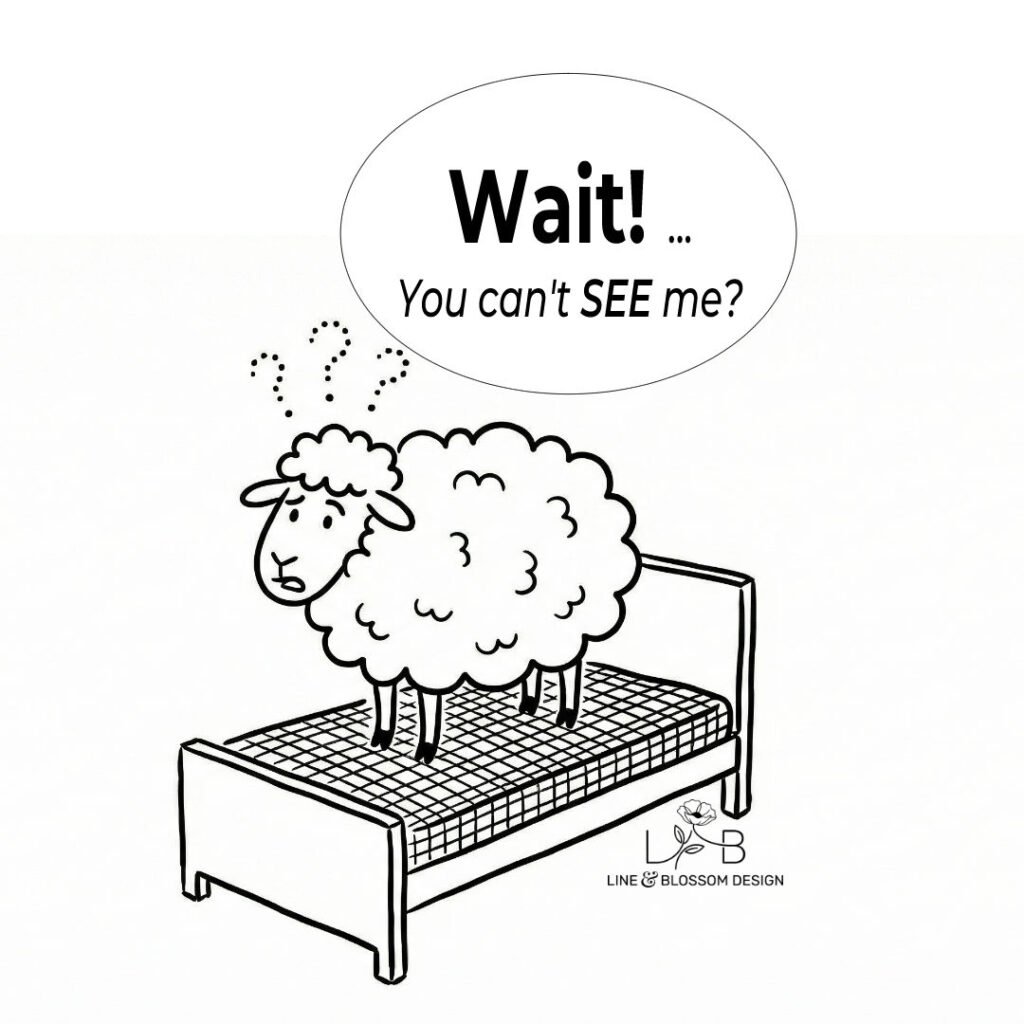
The above image was created with the help of AI and a strong prompt. I tried for over an hour to draw that confused sheep, but if you have followed along you know I don’t draw animals. See my blog post describing the Koala Incident. Think about the image, then think about it from the opposite perspective.
If you have a mind’s eye you see sheep, now think about not seeing them and that poor sheep. If you have a blind mind’s eye, like me, you understand why that poor sheep is so confused, but also think what it would be like if you did “see” it.
For me the idea of seeing sheep in my mind is, like the title says, CREEPY. Forget counting them, I would be too afraid. The reason I ask this is if you take a moment to picture the world from someone else’s eyes (literal or mental) you begin to understand more about them. Also by understanding them a bit more, you may find you understand yourself a bit more too.
Your Questions About Aphantasia and Art
I know this concept can be hard to wrap your head around (pun intended). So, what questions do you have?
Whether you are curious about:
- How I dream (yes, I dream)
- How I remember directions
- How I learn new drawing techniques
- Whether I can enjoy movies and books
- How I recognize faces
- Or just want to know more about the “black screen”
Ask away in the comments. I will do my best to answer or explain!
And if you’re an artist with aphantasia, or someone just beginning their drawing journey with this condition, I’d love to hear about your experience. How do you create? What techniques work for you? Let’s learn from each other.
