Introducing 22oz Copper Insulated Water Bottles! Cold for 48 hours & Hot for 12. In the SHOP Now

After the Art of Subtraction: How to Find Your Art Style That ‘Sings’
You found your subject. Now comes the harder part. To Find your art style means going on a few bad dates, making a mess, and occasionally framing something you never plan to repeat. This is the story of how I found mine.
 ByLeona

Moving from Subject to Style in Your Beginner Drawing Journey
In my post, How to Find Your Art Style: The Subtraction Method for Beginners, I gave you a strategy to find your subject by eliminating everything you hate. Now it’s time to find your art style.
If you followed that advice, you might be holding a piece of paper that says: “I draw cars” or “I draw landscapes” or, in my case, “I draw flowers.”
Congratulations! You have found your Subject. But you haven’t found your Style.
Knowing what you love to draw is only half the battle. Now you have to figure out how you want to draw it. And to do that, you need a two-step plan: The Search and The Experiment.
Understanding the difference between subject and style is crucial for beginner artists. Your subject is the “what”, flowers, portraits, animals, architecture. Your style is the “how”, realistic, abstract, minimalist, detailed, colorful, monochrome. Both matter, but they require different discovery processes.
Step 1: Dive Down the Rabbit Hole (The Search Method) to Find Your Art Style
Before you pick up a pen, you need to flood your brain with possibilities. You need to see how a thousand other artists have tackled your specific subject.
This is the fun part. This is when you give yourself permission to dive down the deep, endless rabbit hole of art.
How to Search for and Find Your Art Style
Grab your phone, open Instagram, Pinterest, or Google, and start searching. But don’t just search for “Art.” Be specific. Hunt for your survivor subject in every conceivable style.
The more specific your searches, the better your results. Instead of broad terms, combine your subject with style descriptors:
Examples of Effective Search Terms:
- “[Your subject] + illustration”
- “[Your subject] + watercolor”
- “[Your subject] + line art”
- “[Your subject] + realistic drawing”
- “[Your subject] + abstract art”
- “[Your subject] + minimalist style”
- “[Your subject] + detailed sketch”
- “[Your subject] + ink drawing”
The goal is to see the full spectrum of what’s possible with your chosen subject.
My Search for “The One”
When I realized my subject was flowers, I didn’t just stop there. I went looking for every variation I could find.
I typed in everything I could think of:
- “Floral illustrations”
- “Flower drawings”
- “Botanical art”
- “Botanical line art”
- “Watercolor flowers”
- “Realistic peony drawings”
- “Minimalist floral design”
- “Black and white flower art”
I looked at watercolors. I looked at realistic pencil shading. I looked at abstract blobs. I scrolled through thousands of images, waiting for a reaction.
This phase took me weeks. I created entire Pinterest boards organized by style. I followed artists whose work caught my eye. I studied not just the finished pieces, but the techniques behind them.
My biggest problem was I got lost as I searched. My old dream of being a landscape artist took control as I searched for my style.
Waiting for It to “Sing”
What are you looking for down this rabbit hole?
You are looking for the image that makes you stop scrolling. You are looking for the style that makes your heart beat a little faster. You are looking for the one that sings to you.
This isn’t a logical decision. You can’t reason your way into knowing which style is “yours.” It’s an emotional, visceral response. When you see it, you’ll know because:
- You’ll save the image immediately
- You’ll go back to look at it multiple times
- You’ll feel excited rather than intimidated
- You’ll think “I want to make THAT”
- Time will disappear as you study it
For me, when I saw highly realistic, shaded pencil drawings of roses, I appreciated them, but they didn’t sing. They felt heavy, laborious, messy, and honestly a bit intimidating for someone just starting their beginner drawing journey.
But when I stumbled upon Botanical Line Art, crisp, high-contrast, black ink on white paper, it didn’t just sing. It shouted. I looked at those clean lines and thought, “Yes. That. That is what I want to do.” As you read on you will discover I got distracted by color and that old dream.
The clarity of the lines, the elegance of the negative space, the way the black ink created such bold statements, it all resonated with something deep inside me. This was to be my artistic voice, even though I hadn’t drawn a single line yet.
Step 2: The “Goldilocks” Phase (The Experiment)
Once you have found the style that sings on the screen, you have to see if it sings on the page.
You have to be Goldilocks. You have to try the porridge that is too hot and the porridge that is too cold before you find the one that is just right. You have to go on a series of bad dates with art supplies.
This is where many beginner artists get discouraged. They see beautiful art online, buy supplies, try once, and when it doesn’t match their vision, they quit. But finding your style isn’t about succeeding immediately, it’s about discovering through experimentation what feels right in your hands.
Understanding the Experimentation Process
I want to be clear that these bad dates didn’t happen one at a time. Many of these mediums overlapped, some running simultaneously for months or years. The order here reflects roughly when each entered my life, not when each left it.
The Goldilocks Phase is about feeling, not perfection. You’re not trying to create a masterpiece with each medium. You’re trying to find the one where:
- Time disappears when you work
- The process feels natural, not forced
- You want to keep going even when it’s hard
- The friction between vision and execution is minimal
- You feel excited to start your next piece
Let me share my own journey through the bad dates, because each one taught me something essential about my artistic voice.
Bad Date #1: The Pencil Phase
Like most beginners learning to draw, I started with the humble graphite pencil.
I did the lessons in Mark Kistler’s book You Can Draw in 30 Days. You can read and see this in my post How to Learn Drawing at Any Age: From No Talent to Artist at 55. And technically, the drawings looked amazing! Friends complimented them. They looked “real.”
But the process drove me crazy.
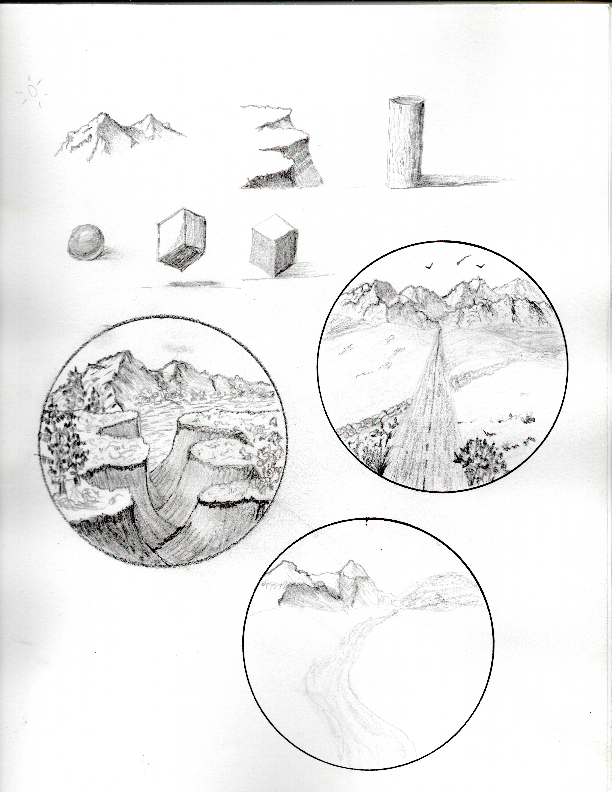
It was messy. My hand would be covered in graphite dust, then smudge the graphite, ruining the crispness I wanted. I’d spend hours blending and shading, trying to achieve smooth gradients. It felt chaotic, not clean and I need my hands to be clean too. Every session ended with graphite-stained hands and a drawing that, while technically competent, felt annoying and fleeting like it would just disappear.
The disconnect was clear: I appreciated the results, but I hated the journey.
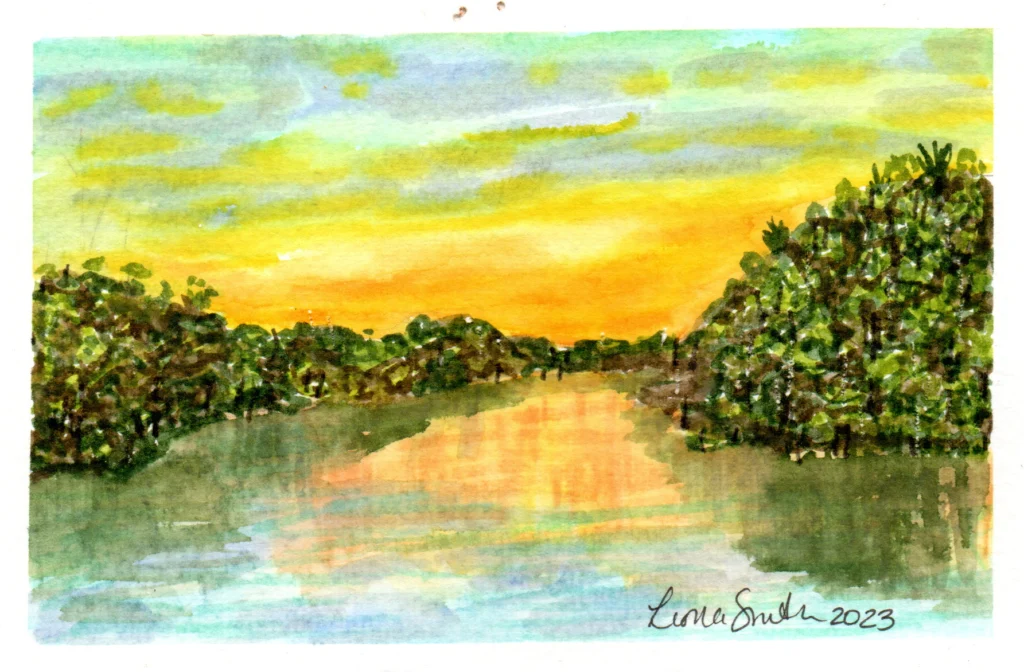
Bad Date #2: The “Bob Ross of H2O” Phase
So, I decided to get fancy. I swapped the pencil for a paintbrush.
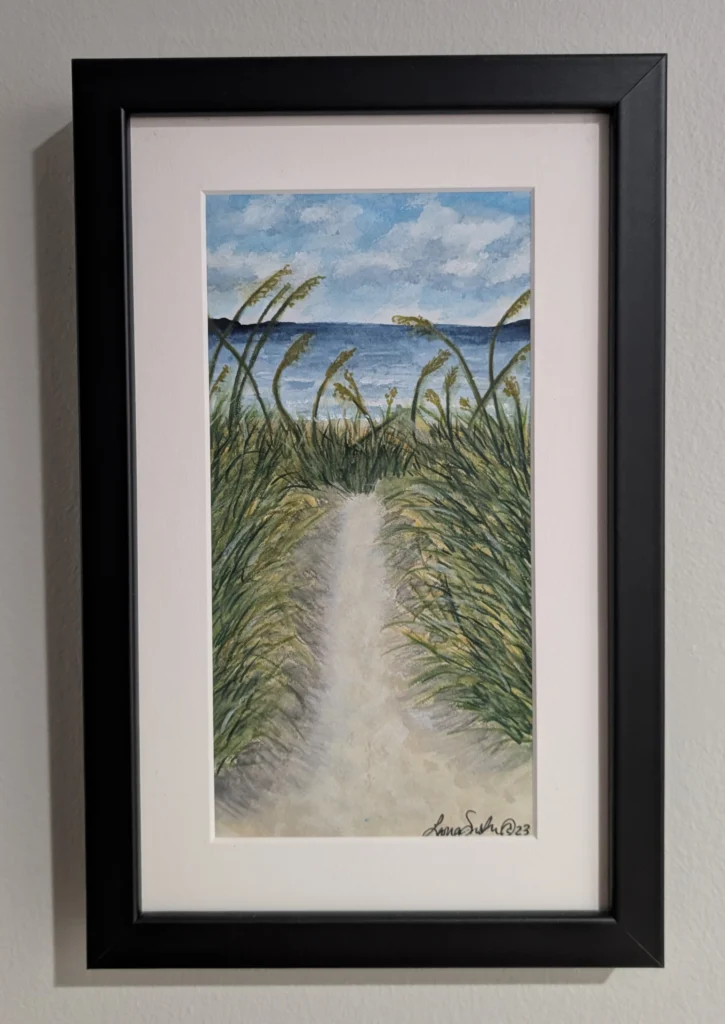
I had this idea in my head that I was going to be the “Bob Ross of H2O.” I bought the paints. I bought the brushes. I tried landscapes, but that was my dream I was suppose to subtract. You see, every watercolor painting I did was via step-by-step books and video paint-alongs.
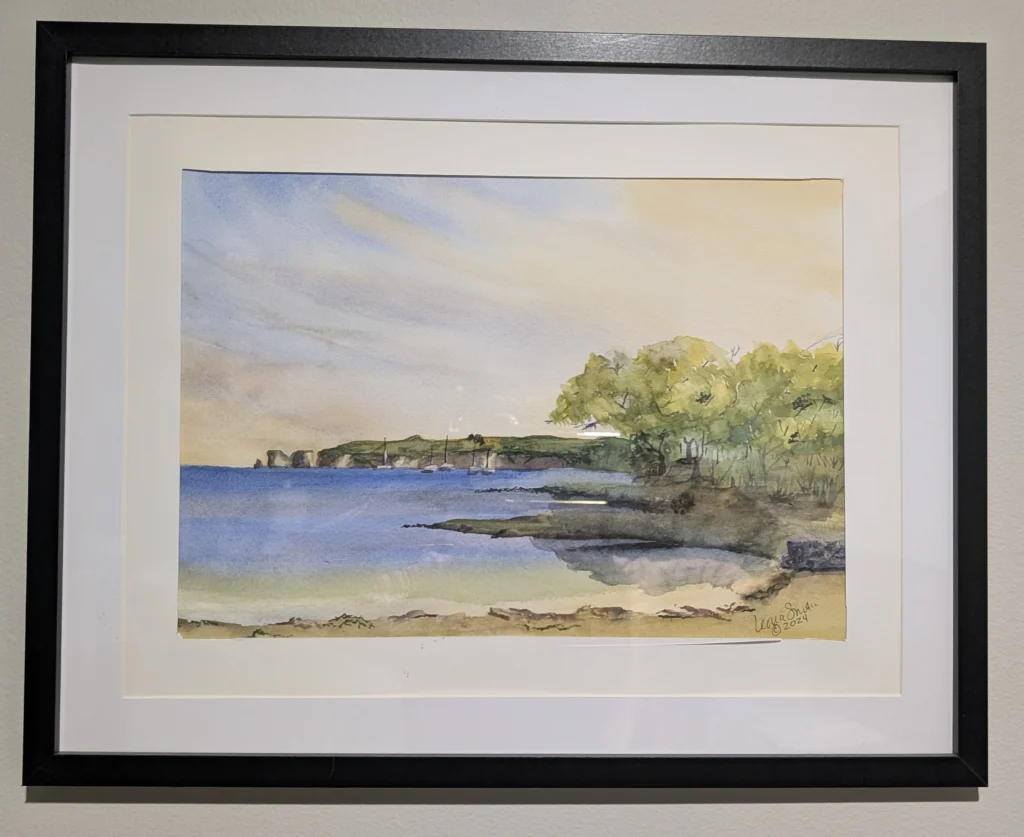
This painting is framed and hanging in my home, I love it. The biggest issue; it is not entirely mine. I followed a paint-along video by Oliver Pyle on YouTube. This is his concept, his idea, I just painted it.
The key reason watercolor painting had to be subtracted was my aphantasia. I am not capable of creating my own unique works. I must use references or books and even if that reference is a royalty free picture I find online, to me it is still someone else’s work. It was very painful to finally subtract this.
Bad Date #3: The “Too Quiet” Phase (Colored Pencils)
I realized paint wasn’t for me, but I still wanted color. So, I tried colored pencils. I ended up with a full set of both Faber Castell Polychromos and Prismacolor pencils.
On paper (pun intended), colored pencils seemed perfect. They offered:
- Control and precision
- No drying time
- Easy corrections
- Vibrant colors
- No mess
But these were just too time-consuming. It would take me hours, sometimes days, to complete a single piece, layering and blending. When I created the leaf in the image I remember looking at it in awe, thinking Wow. The depth I had achieved, that veining. For a bit I was mesmerized.
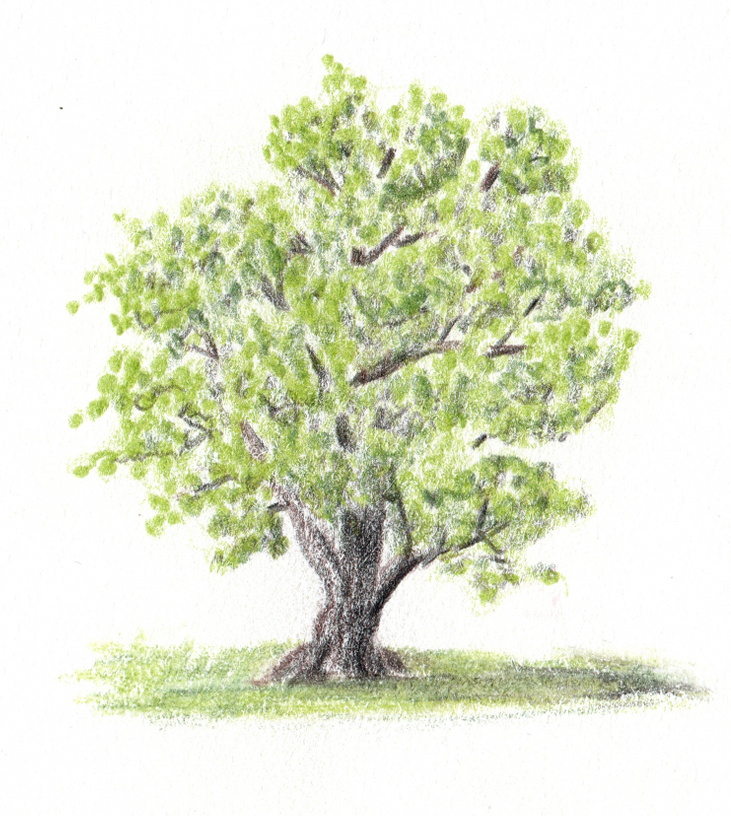
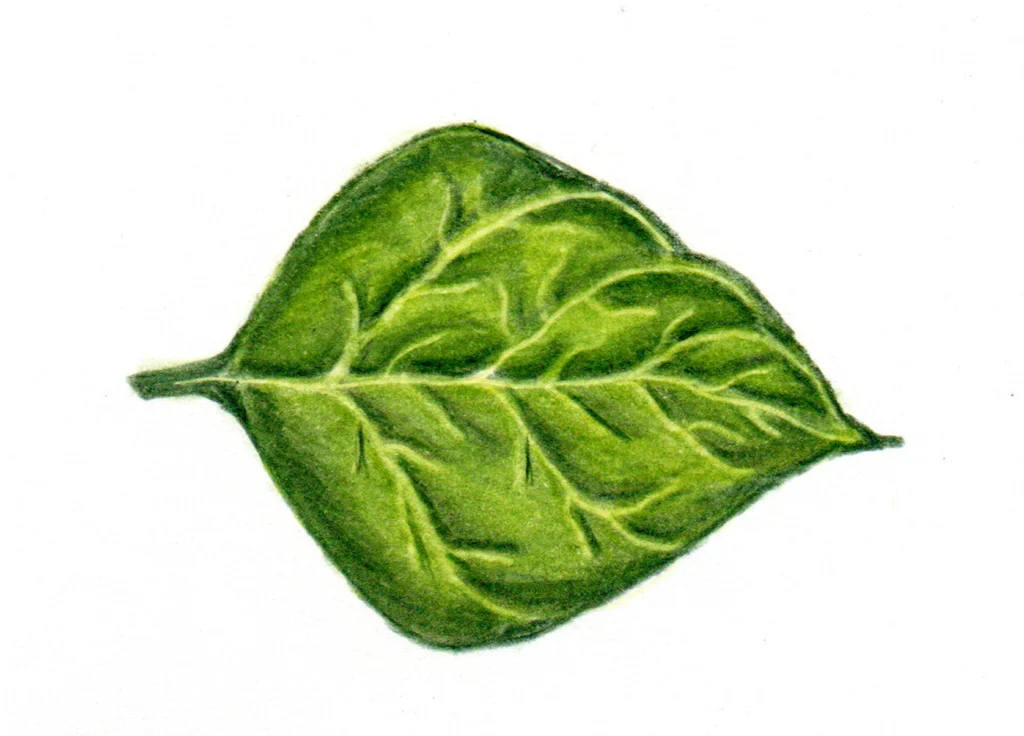
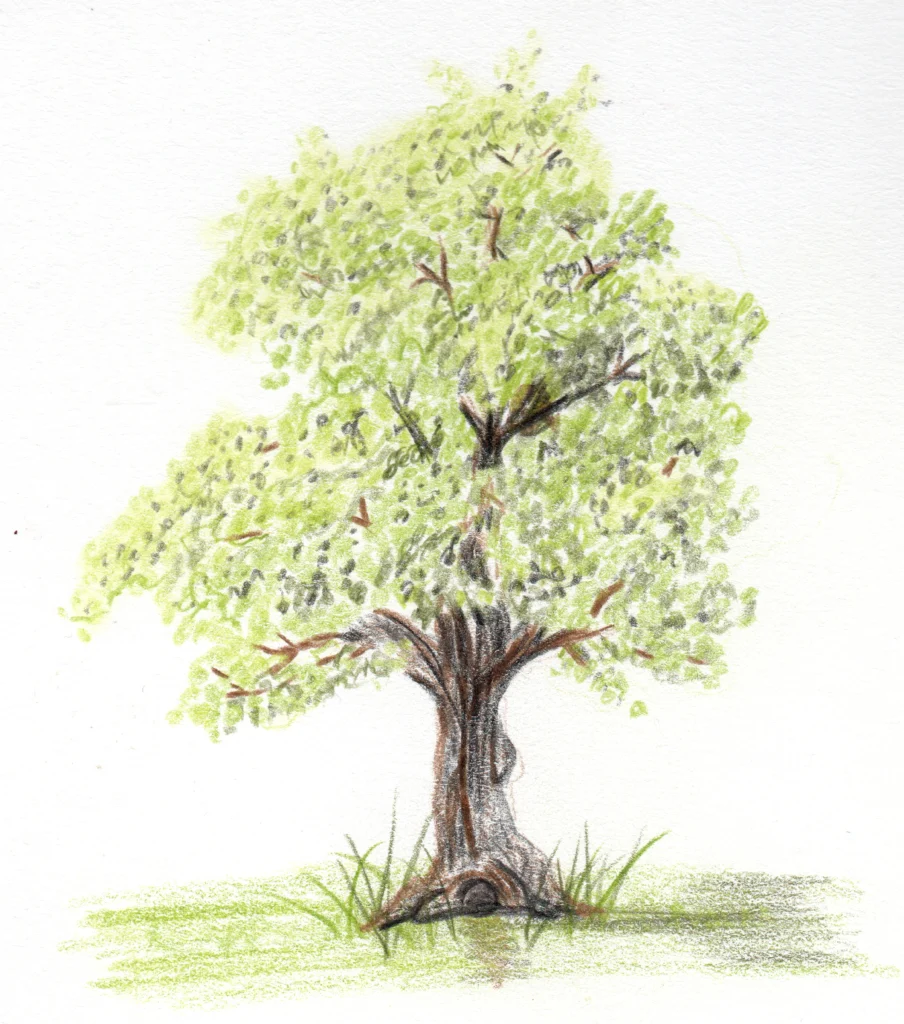
Sometimes it was hours of layering to achieve the depth and color I wanted. I am particularly proud of that “simple” leaf. It is beautiful, but it took a lot of time and several additional blending tools to achieve. However, it didn’t sing.
The colored pencil drawings I created always felt like something was missing. It wasn’t until I created that leaf that I finally understood what. I kind of missed the black ink. I was so focused on color that the importance of that thought didn’t truly sink in until I went on a couple more bad dates.
Bad Date #4: The “Too Loud” Phase (Markers)
Since the pencils felt too quiet, I swung hard in the other direction. I picked up markers. I filled every inch of the page. I added patterns, textures, and bright colors, trying to force the energy into the piece.
Surely, if quiet was wrong, loud must be right!
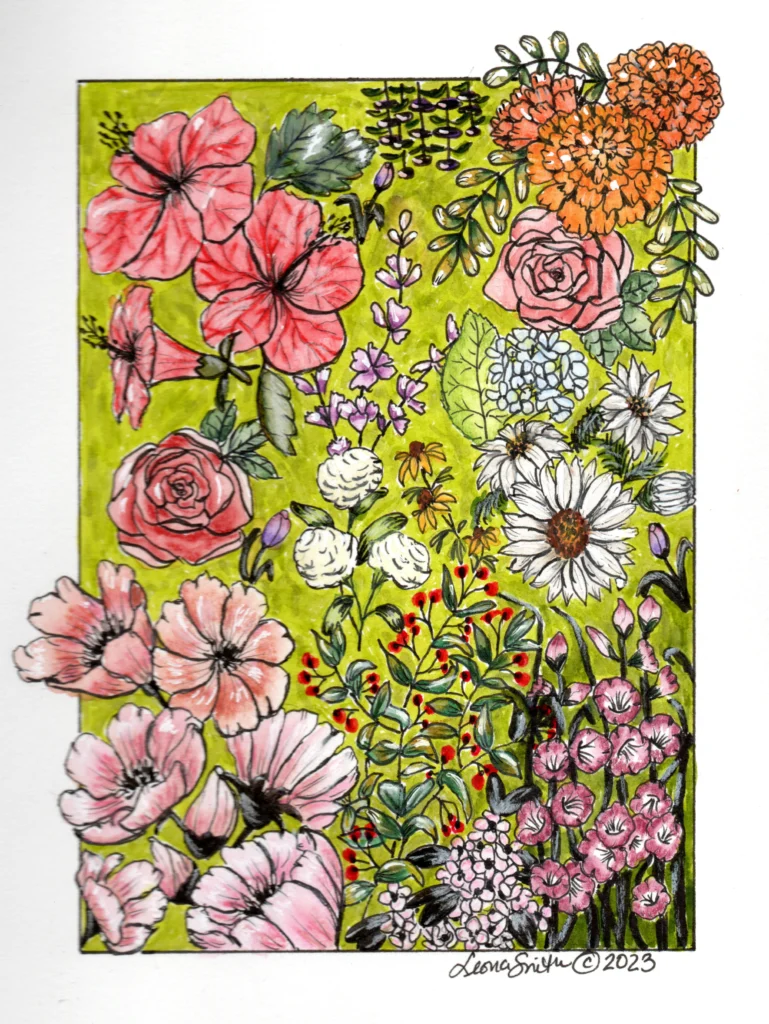
The “Too Loud” Phase. I tried to fix the quietness by adding everything, patterns, multiple colors, filled spaces. But looking at this piece, I realized it was overdone. It was chaotic. It didn’t sing; it screamed. While the tropical one doesn’t feel quite so garish, it still wasn’t right.
The marker phase taught me a valuable lesson: More isn’t always better.
I had over-corrected. In trying to add energy and impact, I’d created visual noise. The delicate beauty of the botanical forms got lost in the competition for attention. Every element fought for dominance, and the result was exhausting to look at.
This was a crucial moment in my artistic development. I was getting warmer, I’d found energy and boldness, but I’d overshot the mark.
Bad Date #5: Do We Have to Discuss This (PanPastels)
Diving down art rabbit holes online by this time was a constant, I guess my hobby. I happened upon several artists that used PanPastels to create amazing works, Landscapes, Animal Portraits, Still-life, Florals. I was enthralled, the color, the cool little tools to keep your hands clean.
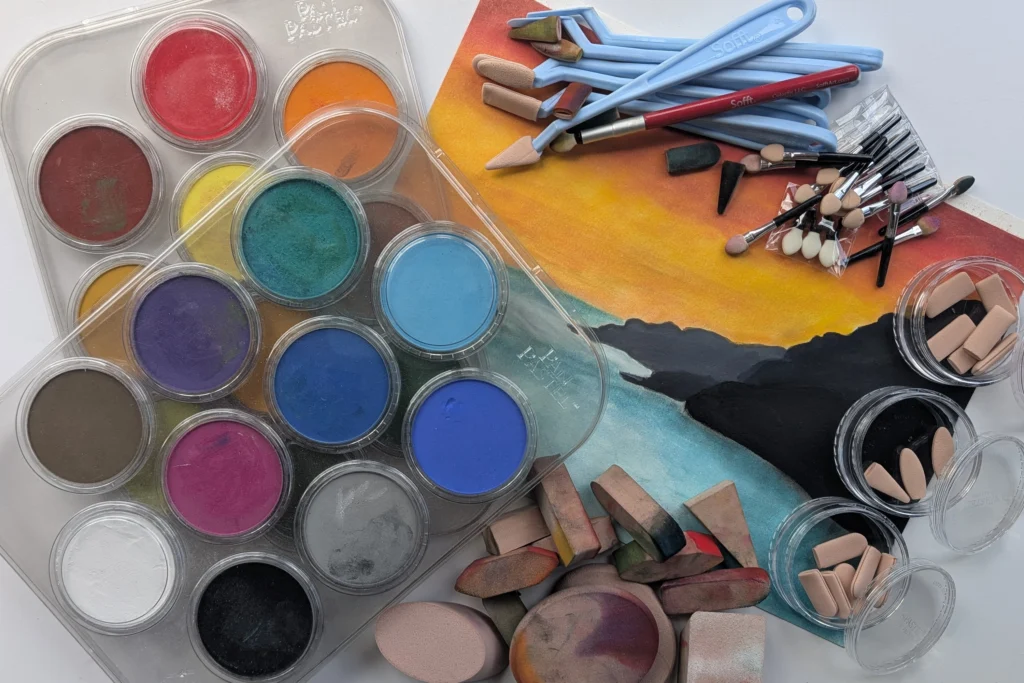
Again, I fell into the Gear Myth. I purchased 2 sets of PanPastels, several sets of tools and the replacement sponges, Pastel Paper in black, white and other colors.
I sat down and started using them. OMG! The mess, all over me, my clothes, my desk. This was a living nightmare! I did manage to create a couple of cool pieces, but I would much prefer to forget I ever went on this date. This date only lasted for about a week.
The amazing colors and blends I was able to achieve are evident as you can see in the image. The problem was I knew I would go insane using these messy *bleep*. What I learned: some art supplies, while beautiful, should be left on the shelf. Listen to your gut, I wish I had.
Bad Date #6: Everything But the Kitchen Sink
After experimenting with so many mediums and having so many supplies (Yes! The Gear Myth bit me) I decided to try something completely different. I saw an image on Pinterest and decided to use it for inspiration.
For this piece I used:
- Watercolor paint
- Albrecht Dürer watercolor pencils
- Faber-Castell Polychromos pencils
- Prismacolor colored pencils
- Gouache
- Tombow markers
Needless to say, this piece took quite a while to complete, but it holds the distinction of being the very first piece of artwork I had professionally framed. Even today I look at thins hanging in my home and I’m still amazed I did it.
While I still occasionally use, or better yet dream about using, many of these mediums, I know they are not part of my artistic song. Just because I can create with them doesn’t mean I should.
Bad Date Conclusion
While I am calling all of these experiences “bad dates” the results more often than not, were anything but. I can promise your results will be similarly surprising as you experiment, some amazing, some horrible, and others you want to forget. The most important part of creating art is not the end result, it is the process and the joy you have along the way.
If you dread pulling out what you need to create art, the mess it creates, or time commitment then your art journey will be stunted. Don’t allow yourself to get pigeonholed into using a medium solely because of how beautiful a piece turned out.
I am primarily a digital artist now, so my tools are a computer with Clip Studio Paint installed, drawing tablet and stylus. As an artist with aphantasia (which you can read about here and here) these tools have given me freedom to draw without the need for constant references. Control Z and the ability to move things around to improve a collage are priceless. For me, going digital turned out to be the best artistic decision I ever made. Now, my artistic song is something I love hearing.
The Final Subtraction: The Lightbulb Moment
I looked at that chaotic, colorful page from my markers, the time-consuming colored pencils, thought about the horrid mess of PanPastels, and my professionally framed kitchen sink, then realized: “This is too much.”
I had found the energy, but I had lost the elegance. I needed to delete something.
That was the final piece of the puzzle. I stripped away the busy patterns and the competing colors. I realized I loved simple black line art, but I needed to use color as a spotlight, not a floodlight.
My “Just Right” Formula
When I used a solid, intentional background color to let the black lines pop, without the noise, the clock disappeared. The friction vanished. It sang.
My final style combines:
- Bold black ink lines (the clarity and precision I craved)
- Solid or simple background colors (the impact and energy markers gave me)
- High contrast (the crispness that made me fall in love with botanical line art)
- Clean white space (the elegance I couldn’t achieve with other mediums)
This is how I arrived at the style you see in all my Line & Blossom Design work today. It wasn’t the first thing I tried. It wasn’t even the fifth. It was the result of systematic experimentation and honest self-assessment. While I do love using background color, I begun to pay more attention to what the artwork wants/needs and sometimes that is just black and white.
The Science Behind “The Sing”: Understanding Creative Resonance
Why does one style “sing” while another doesn’t? There’s actually psychology behind this.
Personal Alignment: Your ideal art style aligns with your personality, energy level, and natural inclinations. If you’re detail-oriented and patient, intricate pencil work might resonate. If you’re bold and energetic, maybe gestural charcoal sketches feel right.
Authenticity Recognition: When something truly aligns with your artistic voice, your brain recognizes it immediately. It’s the same feeling as hearing a song that perfectly captures your mood, instant recognition of “yes, this is me.”
How to Find Your Song: The Complete Method
You cannot think your way into a style. You have to work your way into it.
You start by looking (The Rabbit Hole) to see what inspires you. Then you start doing (The Goldilocks Phase) to see what feels natural.
One method will make you feel like you are fighting the paper. Another one will make you feel like you are dancing with it.
Signs You’ve Found Your Style
Green Flags (You Found It!):
- You lose track of time while working
- You’re excited to start the next piece before finishing the current one
- The technical challenges feel like puzzles, not obstacles
- You don’t feel the need to apologize for or explain your work
- You want to practice more, not less
Red Flags (Keep Looking):
- You dread the setup or cleanup process
- You constantly compare your work negatively to others
- The medium fights you at every step
- You feel relieved when a piece is “finally done”
- You make excuses for why it “didn’t turn out right”
Common Pitfalls to Avoid
Pitfall #1: Copying Someone Else’s Style
It’s tempting to try to replicate exactly what made you stop scrolling, but your style needs to be yours. Use inspiration as a starting point, not a destination.
Pitfall #2: Giving Up Too Soon
You might need to try 5, 10, or even 15 different approaches before finding your “just right.” That’s normal. Each “bad date” eliminates options and brings you closer.
Pitfall #3: Ignoring Your Process Feelings
If you hate the process but like the results, you won’t sustain the practice. Choose a style where both the journey and the destination feel good.
Pitfall #4: Skipping the Experimentation
You can’t think your way to your style, you must physically experiment with different mediums and approaches. Theory and research aren’t enough.
Your Assignment: Find Your Art Style
Take the “Survivor” from your Subtraction list (the subject you didn’t hate).
Step 1: Dive Down the Rabbit Hole to Find Your Art Style (1-2 weeks)
Go to Pinterest or Instagram and find at least 3 completely different styles for that subject.
Example for “Flowers”:
- Realistic pencil shading
- Loose watercolor
- Bold graphic illustration
Example for “Portraits”:
- Charcoal realism
- Cartoon/anime style
- Minimalist line drawings
Example for “Landscapes”:
- Detailed pen and ink
- Impressionist painting
- Flat color illustration
Save at least 10-15 examples of each style. Study them. Notice what makes your heart beat faster.
Step 2: The Goldilocks Experiment (3-6 months)
Try to draw your subject in those 3 styles. But here’s the critical part: Don’t just try each one once.
For each style, create at least 3-5 pieces before making your judgment. Your first attempt with any medium will be awkward. Your second might be frustrating. By the third or fourth, you’ll start to understand whether the friction is temporary (learning curve) or permanent (wrong fit).
Be sure to not fall for the Gear Myth! You don’t need hundreds of markers, several sets of PanPastels, or the most expensive colored pencils and paint. Start with the bare minimum, even just a few of any medium is enough to experiment with.
Track Your Experience:
- How did you feel during the process?
- Did time fly or drag?
- Were you excited to try again or relieved to be done?
- Did the medium cooperate or fight you?
- Did the result match your internal sense of “rightness”?
Step 3: Listen to Your Creative Voice
Don’t worry about the outcome. You aren’t trying to make a masterpiece; you are auditioning tools. Listen to how you feel while you are using them.
When you find the one that makes you forget the time… stop looking. You found your voice.
The Subtraction Continues: Refining Your Discovered Style
Even after you find your art style direction, the subtraction method continues. My journey didn’t end when I discovered botanical line art, that’s when the real refinement began, along with a few missteps.
Micro-Experiments Within Your Style
Once you find your art style and its general direction (line art, for me), you still need to discover:
Line Quality:
- Thick or thin lines?
- Consistent width or varied?
- Smooth or textured?
- Precise or loose?
Composition Approach:
- Minimal or densely detailed?
- Centered or asymmetrical?
- Realistic proportions or stylized?
- Simple or complex?
Color Strategy:
- Monochrome or limited palette?
- Backgrounds or no backgrounds?
- Color as accent or primary element?
I experimented with all of these variables within my chosen style of botanical line art. Each refinement brought me closer to the specific voice that felt uniquely mine.
Why the Goldilocks Phase is Essential for Beginner Artists
Many beginner drawing tutorials skip this step entirely. They teach you how to use a pencil or how to mix paint, but they don’t teach you how to discover which tool is yours. How to actually find your art style.
The Goldilocks Phase is essential because:
It Builds Genuine Skill:
You’re not just reading about techniques, you’re physically practicing them. Even the “bad dates” teach you about control, composition, and color.
It Develops Your Critical Eye:
By creating work in different styles, you learn to evaluate art more deeply. You understand why something works or doesn’t work for you.
It Saves Time Long-Term:
Yes, experimenting takes months. But it prevents you from spending years doing work that doesn’t fulfill you, using supplies that frustrate you, or pursuing a style that isn’t authentically yours.
It Builds Confidence:
When you finally find your style, you know it’s yours. You didn’t copy someone else or follow a trend, you discovered it through systematic exploration.
Common Questions About Finding Your Art Style
“How long does this take?”
The Search phase might take a few weeks. The Goldilocks Phase can take 3-6 months or longer. Finding your refined style is an ongoing journey that continues for years. Be patient with yourself. Know that your style will evolve over time.
“What if I like multiple styles?”
That’s perfectly fine! Many artists work in 2-3 different styles depending on the project or their mood. You don’t have to limit yourself to one forever.
“What if my style changes over time?”
It will, and that’s healthy artistic growth. Your style at the beginning won’t be your style in 5 years. Keep experimenting and know that your style will evolve over time.
“What if nothing sings to me?”
Keep searching. Expand your sources. Look at historical art, different cultures, craft traditions, design work. Your inspiration might come from unexpected places.
“Do I need expensive supplies to experiment?”
No! Start with basic, affordable supplies for each medium. Like I said earlier, sometimes it only takes a few items of a medium to experiments. Once you find your art style, invest in better quality tools. Don’t buy premium watercolors if you’re still figuring out whether watercolor is your medium (like I did).
The Gift of Bad Dates: What Failure Teaches
Each of my “bad dates” with art supplies taught me something invaluable:
- Pencils taught me I value crispness over softness.
- Watercolor taught me I need control over unpredictability.
- Colored pencils taught me I crave impact over subtlety.
- Markers taught me I need elegance, not just energy.
- PanPastels taught me… let’s not discuss this date.
- Kitchen Sink taught me how much I craved simplicity.
None of these were wasted time. Each eliminated an option and clarified my preferences. Each brought me closer to understanding my creative voice. Each one added to my artistic song in its own way.
Finding Your Art Style: Take the First Step
Your artistic style already exists, you just haven’t discovered it yet. It’s waiting in the intersection between what makes you stop scrolling and what makes you lose track of time while creating.
The Search and Experiment method isn’t quick or easy, but it’s honest. It respects your unique creative voice instead of trying to force you into someone else’s mold.
Remember: The goal isn’t to find the “best” style, it’s to find YOUR art style. The one that makes your heart sing. The one where the clock disappears. The one that feels like coming home.
For examples of my style visit my Shop @ Line & Blossom Design.
