Introducing 22oz Copper Insulated Water Bottles! Cold for 48 hours & Hot for 12. In the SHOP Now
Why a Vintage Key? The Hidden Symbol in My Hidden Object Art.
Every Line & Blossom Design print hides a vintage key. It isn't just a puzzle piece. For over 20 years, a small key has traveled everywhere with me, carrying a message that changed how I see locked doors and open ones. This is the story behind the symbol.
 ByLeona

The Hidden Meaning in Every Line & Blossom Design Drawing
If you look closely at any piece of art from Line & Blossom Design, you will find something hidden among the petals and stems. Sometimes it takes a moment to spot it, but it is always there: a vintage key.
I get asked often, “Why a vintage key? Is it just for fun?”
While I love “hidden object puzzles,” the key isn’t just a puzzle piece. It is a symbol I have carried with me, literally, for over two decades. And understanding why this hidden symbol appears in every single drawing reveals not just my artistic process, but the entire journey of how I became an artist in my 50’s.
The Simple Vintage Key on My Keychain: A 20-Year Companion
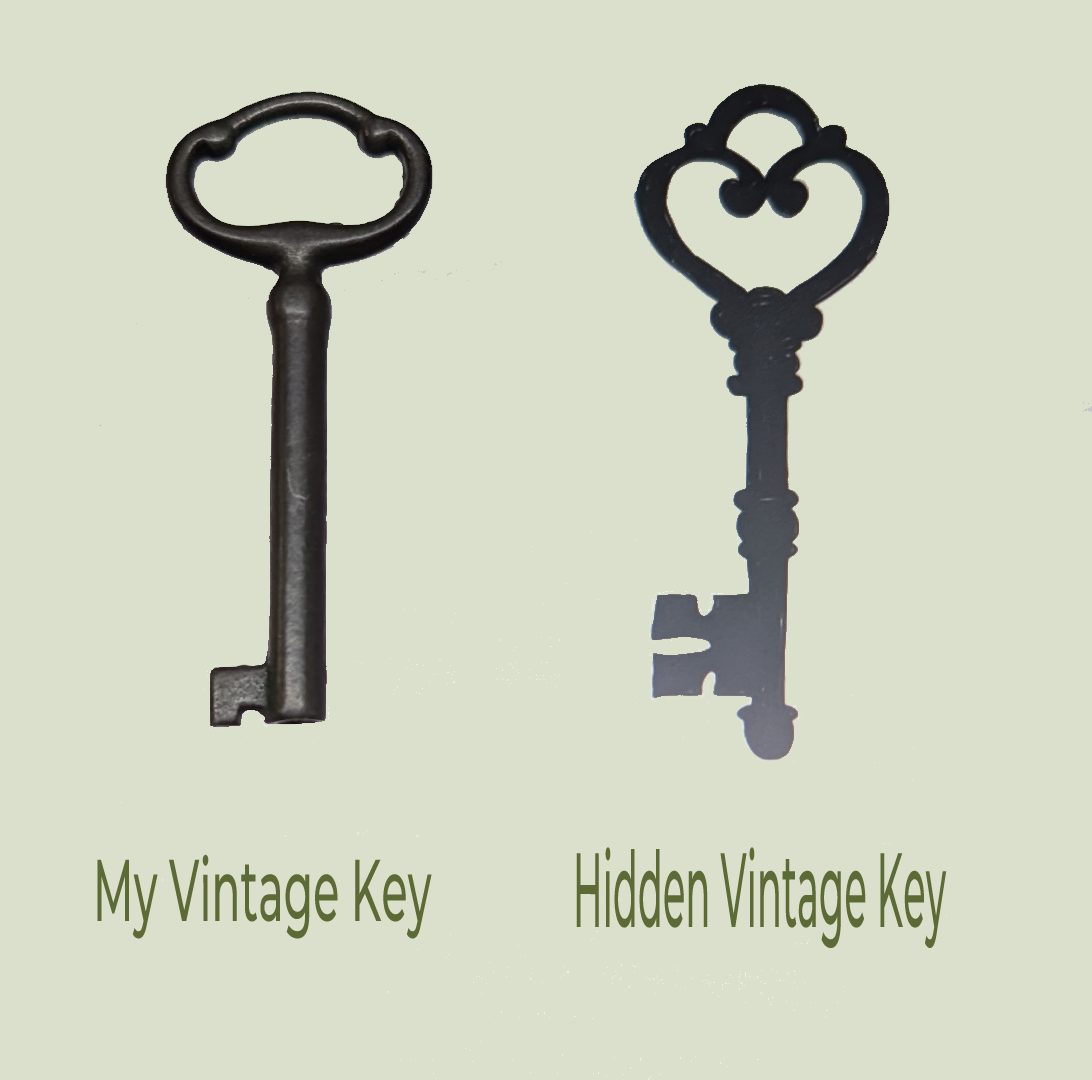
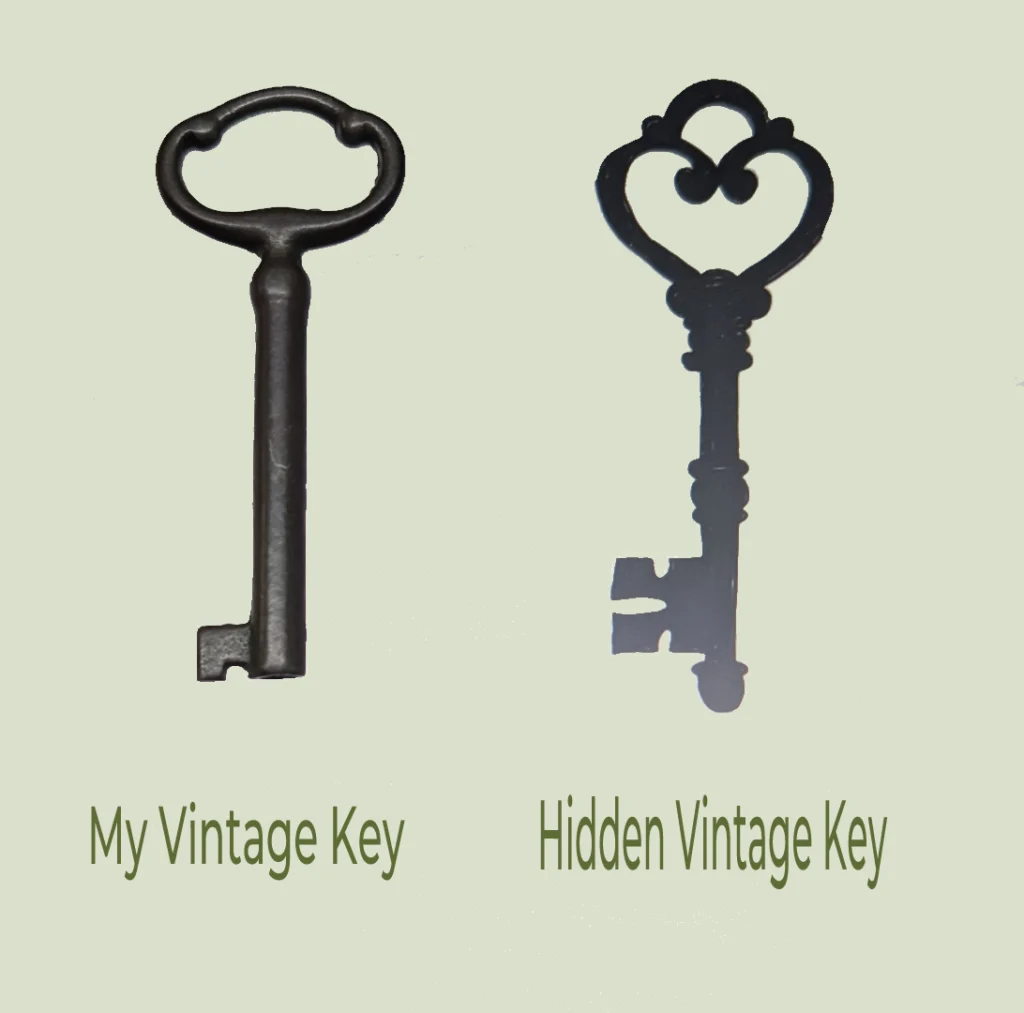
For over 20 years, I have carried a simple vintage key on my keyring. It jingles alongside my house keys and car fob, a constant reminder of a gift I received long ago.
The person who gave it to me offered it with a very specific message. They told me that I should be the one to hold the key to the skeletons in my closet.
At the time, it was a symbol of control. It meant that I owned my life, my history, and my secrets. It was a reminder that I had the power to keep the bad things locked away, or to open the doors blocking my path at any given time. It was a symbol of survival and agency.
The Power of Physical Symbols
There’s something profound about carrying a physical object that represents an internal truth. Unlike a mental affirmation or a journal entry, this vintage key is tangible. Every time I reach for my house keys, I feel its weight. Every time I hear it jingle, I’m reminded of the message it carries.
For two decades, that vintage key has been my personal talisman, a small piece of metal that holds enormous meaning. It’s witnessed every major life transition, every challenge, every victory. It was in my pocket when I faced my darkest days, and it was there when I picked up my first drawing pencil at 55.
The key didn’t just represent abstract concepts of freedom or control. It became a promise I made to myself: I would never again give someone else the power to lock doors in my life.
When Symbols Take on New Life: The Creative Awakening
When I decided to pick up a pencil at age 55, that simple vintage key on my keyring started to take on a new meaning.
Anytime you open a proverbial door, it is, to some degree, scary. You never know exactly what will be behind it. For me, the fear was specific: my family had always insisted I didn’t have any talent (a story I share in my first post, How to Learn Drawing at Any Age: From No Talent to Artist at 55).
The Fear of Turning the Lock
Standing at the threshold of creativity, I faced a locked door I’d avoided for 55 years. Behind it was the question: What if I try to create art and fail? I did, and you can read about my painting failures.
My family’s voices echoed in my head:
- “You’re not artistic.”
- “You don’t have that kind of talent.”
- “Drawing is for other people, not you.”
- “You need to give up being creative.”
These weren’t just casual comments, they were messages I’d internalized for decades. They had built a thick, heavy door between me and creative expression, and they’d convinced me I didn’t have the key to open it.
But then I looked down at my keychain. That vintage key, the one that reminded me I controlled my own life, seemed to glow with new purpose.
Putting on My “Big Girl Pants”
Staring at that door, the doubts crept in. What if they were right? What if I just fail?
But the key reminded me that I was in control. I put my “big girl pants” on and turned that key, deciding to let the cards fall where they may. I realized I didn’t need someone else to open the door for me; I could do it myself. I had the key!
That moment, that conscious decision to turn the key despite the fear, changed everything. I wasn’t waiting for permission anymore. I wasn’t waiting for someone to tell me I was “allowed” to be creative. I was claiming it for myself.
The vintage key, which had symbolized control over my past, now represented permission to create my own future.
From Keychain to Canvas: How Art and Symbol Merged
Last year when I was thinking about selling my art online, I had another huge locked door in front of me. I thought about that vintage key and unlocked it. I started thinking about the botanical collages I loved drawing and decided that hiding items would be perfect. I wanted everyone to have a vintage key to open their doors.
Several years back I created a botanical collage for some friends as a housewarming gift. I started with the initial of their last name in the center and drew the collage around it. After I completed it, I decided to hide, on a whim, their first name initials throughout the drawing. Unbeknownst to me at the time, doing this was very meaningful to them.
As you can probably guess now, consciously thinking about that simple vintage key and selling my art combined and hiding a key in every piece was born.
Why Vintage Keys Resonate in Art
The vintage key is rich with symbolism that extends far beyond my personal story:
Historical Meaning:
- Keys represent access, authority, and control
- Vintage keys specifically suggest universal solutions, one key that opens many locks
- In vintage contexts, they evoke nostalgia and mystery
Metaphorical Power:
- Keys unlock potential and possibility
- They represent secrets, both kept and revealed
- Finding a key suggests discovery and revelation
Visual Appeal:
- The ornate design of vintage keys is inherently beautiful
- Their intricate details mirror the complexity of botanical art
- They create visual interest through contrast with organic forms
This symbol works on multiple levels: it’s personal to my journey, universal in its meaning, and visually compelling in composition.
The Hidden Key Ritual: How I Create Hidden Object Art
Now, that same key, the one remarkably similar to the physical one in my pocket, makes its way into every drawing. But the how is just as important as the why.
My Creative Process
Step 1: Draw the Complete Piece
I actually draw the entire piece first, every petal, every leaf, every branch. I don’t plan where the key will go. I don’t leave a space for it. I create the artwork in its entirety, letting the composition flow naturally.
Step 2: Study the Finished Drawing
Only when the drawing is complete do I stop and analyze it. I step back and really look at what I’ve created. This is when the hidden object element truly begins, for me.
Step 3: Search for the Perfect Hiding Spot
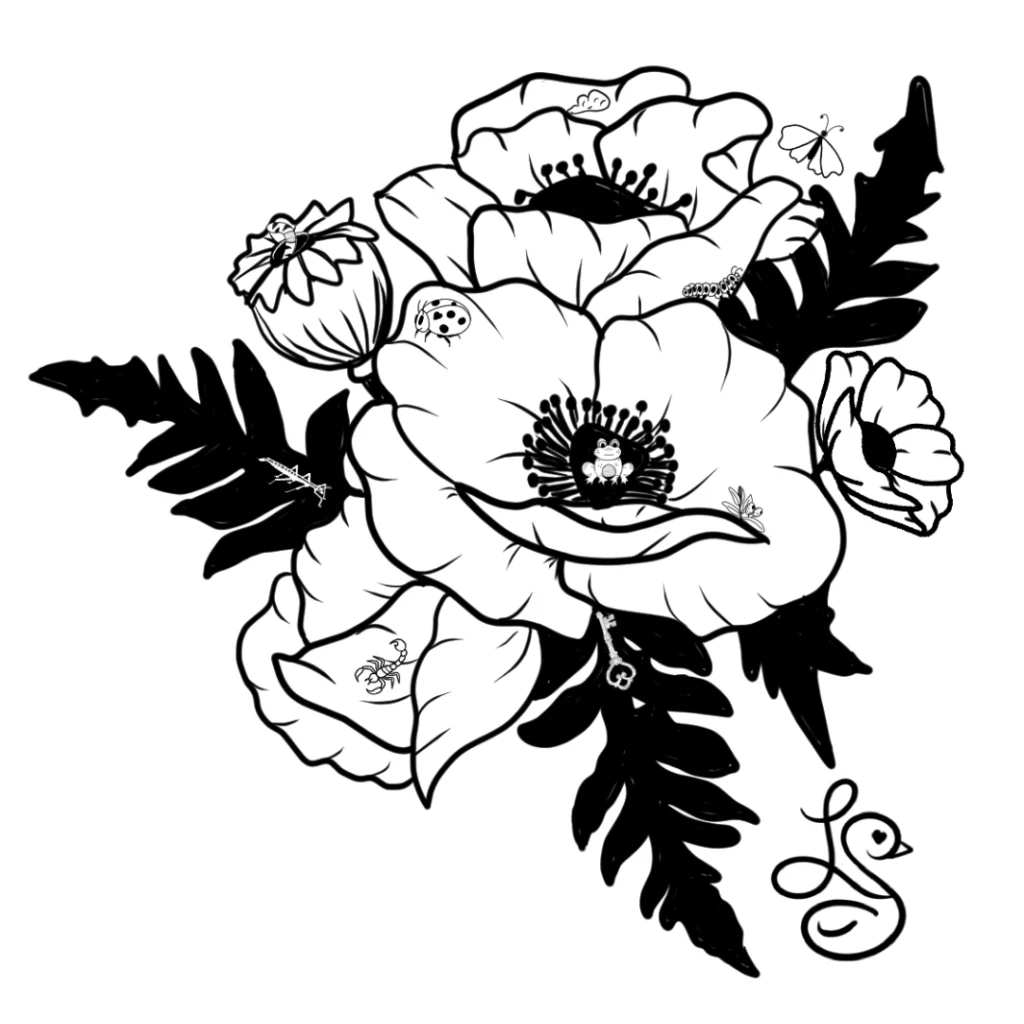
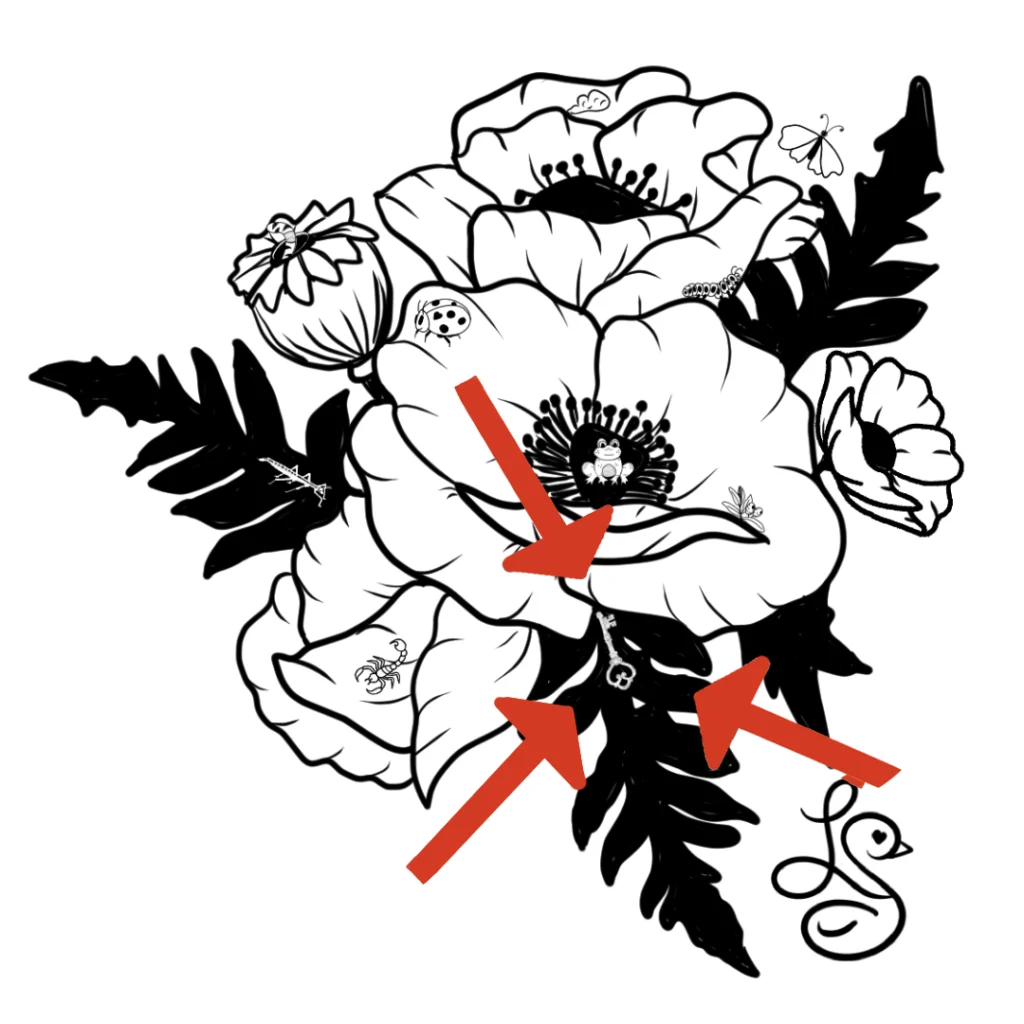
I search the lines I just created, looking for the perfect hiding spot. Where do the curves of petals create a suggestion of a key shape? Where could a key nestle naturally without disrupting the composition? Where can its friend hide? I let the art tell me what should be hidden and where.
Step 4: Place the Key Into the Composition
Once I find the right spot, I place my hand-drawn vintage key from my Clip Studio Paint materials library directly into the artwork. From there I rotate and resize it into the composition so it feels like it always belonged there. Sometimes it’s obvious once you know it’s there. Other times it’s so perfectly integrated that even I have to look twice.
In a way, I am playing the game before you do. I have to find the space where the key belongs before I can put it in.
Why This Process Matters
This ritual is crucial to my creative process. By adding the vintage key after the artwork is complete, I ensure:
- Authenticity: The composition flows naturally without being constrained by needing to “fit” the key or any other hidden element
- Discovery: I experience the same surprise and delight when I find the hiding spot that viewers will feel
- Integration: The vintage key becomes part of the artwork, not just placed on top of it
- Mindfulness: It forces me to truly observe my own creation, seeing it with fresh eyes
This process also reflects my experience with aphantasia (learn more in Why Counting Sheep is Creepy: My Life with a “Aphantasia). Since I can’t visualize the finished piece beforehand, I discover the artwork as I create it, and the vintage key is the final discovery.
A Reminder to Pay Attention: The Deeper Purpose
Why do I want you to find it?
Yes, I want you to have that satisfying “I won!” feeling when you spot it. That moment of achievement when your eyes finally catch the curve of the key’s bow or the shaft hidden among stems, it’s genuinely joyful, and I love giving people that experience.
But deeper than that, I want it to be a moment of mindfulness.
The Art of Paying Attention
In today’s fast-paced world, we often rush through experiences. We glance at art, scroll past beauty, miss the details hiding in plain sight. The hidden key and its friends force you to slow down.
When you search for the key:
- You study the artwork more carefully
- You notice details you might have missed
- You engage actively rather than passively
- You practice patience and attention
These are the same skills we need for life. How many solutions, opportunities, and moments of beauty do we miss because we’re moving too fast to notice them?
Finding the Keys in Your Own Life
The key is my quiet reminder that the solutions we need in life, the “keys” to our own locked doors, are often right there in front of us. We just have to pay attention to find them.
Think about it: How many times have you struggled with a problem, only to realize later that the answer was obvious all along? How many opportunities passed by unnoticed because you weren’t looking for them?
The hidden key in my artwork is practice for seeing what’s already there. It’s a training ground for awareness.
What the Key Means for Your Journey
So, the next time you are looking at one of my prints, and you finally spot that vintage key tucked away in a flower, take a moment. Remind yourself that you hold the keys to your own life and its locked doors. You just have to be willing to turn them.
Questions to Ask Yourself
When you find the hidden vintage key, consider:
- What doors am I standing in front of?
- What opportunities, dreams, or changes am I avoiding because of fear?
- Who told me I couldn’t open them?
- What messages from family, friends, or society have convinced me certain doors are locked to me?
- What would happen if I turned the key?
- What’s the best-case scenario if I claim the control that’s already mine?
- What keys am I already carrying without realizing it?
- What strengths, resources, or permissions do I already possess but haven’t acknowledged?
Your Own Creative Keys
Maybe you’ve been told:
- You’re too old to learn something new (I started drawing at 55)
- You don’t have the talent (neither did I, apparently) Which is a MYTH
- It’s too late to change careers, pick up a hobby, or follow a dream (I’m 60 and starting anew)
- Creative pursuits are frivolous or impractical (creativity feeds the soul)
Those are all locked doors. And somewhere, you’re already carrying the key, you just need to find it and decide to use it.
The Universal Symbol in Hidden Object Art
While my vintage key has deeply personal meaning, it’s become something larger in my work. It’s evolved from a private symbol to a shared experience.
For collectors of my art, the key becomes:
- A treasure hunt and moment of joy
- A reminder of their own agency and power
- A conversation starter about hidden meanings
- A meditation on paying attention to details
For fellow artists, especially those learning to draw later in life, the key represents:
- Permission to create without external validation
- The power to define your own artistic journey
- A reminder that symbolic elements add depth to artwork
- Inspiration to incorporate personal meaning into creative work
For anyone facing locked doors, the key symbolizes:
- The control you already possess
- The courage needed to turn the lock
- The practice of seeing solutions hiding in plain sight
- The truth that you don’t need permission to unlock your own life doors
Join the Conversation: Your Keys and Your Doors
What door have you been afraid to unlock?
Whether it’s a creative dream or a life change, we all have them. Maybe you’ve been wanting to:
- Start drawing or painting
- Write that book you’ve been thinking about
- Change careers to something more fulfilling
- Learn a new skill that seems “too hard”
- Share your creative work publicly for the first time
Or maybe you have your own “key”, a small object you carry that reminds you to be brave. A stone from a meaningful place, a piece of jewelry from someone who believed in you, a note tucked in your wallet.
I’d love to hear your story in the comments below. What symbols carry meaning in your life? What doors are you standing in front of right now? Have you found the key yet, or are you still searching?
Remember:YOU hold the key to any locked doors you find along life’s path.
Can you find the key? Share a photo when you do and tag me on social media! @lineandblossomdesign
